




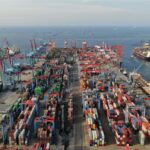
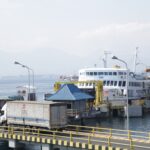

Singapore-flagged MV Sinar Bintan made its maiden call at Patimban, highlighting the port’s growing role in domestic feeder links and international shipping networks across regional trade routes
Shipping connectivity at Patimban Port in Subang, West Java, has expanded with the launch of the ONE-Samudera container service, as the port seeks to strengthen links between domestic feeder routes and international shipping lanes.
The service is jointly operated by Indonesia’s Samudera and Japan’s Ocean Network Express (ONE) under a slot-sharing arrangement.
The Singapore-flagged MV Sinar Bintan, measuring 147 meters in length and with a gross tonnage of 12,563, made its maiden call at Patimban Container Terminal on Aug. 10-11, 2026. The vessel arrived from Tanjung Emas Port in Semarang and continued to Singapore after calling at Patimban.
This service remains a joint slot between Indonesia’s shipping line Samudera and Japan shipping line ONE (Ocean Network Express).
Yukki Nugrahawan Hanafi, commissioner of PT Pelabuhan Patimban Internasional (PPI) and senior vice president of the International Federation of Freight Forwarders Associations (FIATA), said the new service was significant beyond the addition of another shipping route.
He said the service strengthened Patimban’s position within a multi-carrier network linking domestic ports in Java with international shipping lanes.
“The arrival of ONE-Samudera demonstrates Patimban Port’s readiness to become a hub for a domestic feeder network connecting ports in Java with international shipping lanes. The combination of the two forms a healthy hub-and-spoke network,” Yukki said.
At the same time, Patimban Container Terminal was handling the MSC Independent III, a Portuguese-flagged vessel measuring 208.9 meters with a gross tonnage of 26,435. The vessel was sailing from Singapore to Pasir Gudang, Malaysia.
The two vessels were berthed at separate locations and handled simultaneously on Aug. 10-11, marking the first such operation at Patimban, according to Yukki.
“For a newly operational port like Patimban, serving two ships moored simultaneously is a clear demonstration of the port’s readiness, scheduling and operational reliability,” he said.

Yukki said the port was also beginning to attract cargo from industries in its surrounding area, rather than relying solely on transshipment cargo from passing vessels.
“Container loading and unloading volumes will also grow over time, but the commodity trends already demonstrate that Patimban is working as an export gateway for industrial areas in West Java and will certainly continue to support the development of the surrounding industrial areas,” he said.
PPI’s car terminals recorded more than 1.2 million vehicles passing through Patimban from 2021 through 2026, according to company data. The vehicle terminal has a current annual capacity of 250,000 vehicles.
Cargo vessel calls have also increased, with an average annual growth rate of about 10% since 2024, while vessel calls reached nearly 300 by mid-2026, PPI said.
Mohd Arief Agustian, head of the Patimban Port Authority (KSOP), said the expansion of shipping services represented an important development for the port’s role in Indonesia’s logistics network and its links with Asia-Pacific shipping routes.
“The introduction of the ONE-Samudera service is a positive development for Patimban Port. We also want to encourage more vessels to dock and provide a choice of services and connectivity for businesses using our services,” Arief said.
He said the arrival of ONE-Samudera indicated that terminal activity was beginning to grow alongside the availability of port infrastructure.
The development involves PPI, which operates the Patimban Container Terminal as the port business entity under a public-private partnership framework, as well as PT Patimban Global Gateway Terminal (PGT), the container terminal operator, and PT Patimban International Car Terminal (PICT), the car terminal operator.
Yukki said the effectiveness of the public-private partnership (PPP) would be measured not only by infrastructure readiness but also by the ability to generate sustainable traffic and revenue for the government and private-sector partners.
The diversification of shipping services and the terminal’s ability to handle multiple vessels simultaneously were early signs that the partnership was beginning to produce operational results, he said.
The development is also expected to support further investment in cargo-handling equipment, including ship-to-shore cranes and electric rubber-tyred gantry cranes, targeted for completion by the end of 2026.
The Patimban Access Toll Road, which is expected to improve connectivity to the port, is targeted for completion in 2027.
“The PPP collaboration between the government and port business entities such as PPI, PGT and PICT is the foundation that makes all of this possible,” Yukki said.
“Every new ship arriving, every additional TEU is proof that this partnership model is effective. This is crucial capital for Indonesia to continue replicating similar schemes at other strategic ports,” he said.