



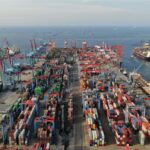

Indonesia’s efforts to increase container port capacity will need to be matched by stronger landside logistics facilities to prevent bottlenecks from shifting from terminals to the next stages of the supply chain, industry experts said.
As container volumes grow, the performance of ports will increasingly depend on the ability of depots, warehouses, trucking networks, industrial estates and other logistics nodes to handle cargo moving out of terminals.
Prof. Kuncoro Harto Widodo, a researcher at UGM’s Center for Transportation and Logistics Studies, said growth in container throughput needed to be accompanied by improvements across the wider logistics ecosystem.
Improving logistics services, he said, required not only physical infrastructure but also data integration, human resources and regulatory support.
National container throughput has recorded positive growth over the past five years, making capacity and connectivity between logistics nodes increasingly important, Kuncoro said.
“A bottleneck at one node will impact other nodes,” he said to media.
Kuncoro called for greater data integration among terminals, shipping companies, depots, trucking operators, industrial estates and government agencies. The National Logistics Ecosystem (NLE), he said, should also be optimized so that information can move as quickly as, or ideally ahead of, physical cargo.
“Ideally, the flow of information should be constant and, if possible, precede the flow of goods,” he said.
He also said rail freight should be developed as an alternative to road-based distribution from ports, which could help reduce reliance on trucks and support efforts to address the country’s “Over Dimension Over Load” (ODOL) problem.
Bottlenecks beyond the port
The importance of landside connectivity was also highlighted by Wahyono Bimarso, a port and logistics practitioner at the Trisakti Institute of Transportation and Logistics (ITL).
Wahyono said Indonesian container terminals had generally improved and now met international standards. But higher terminal productivity would have limited impact if the infrastructure handling containers after they left the port failed to keep pace.
“Our container terminals already meet international standards. The main issue actually arises after the containers leave the port,” Wahyono said.
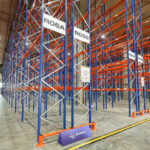
“Loading and unloading speeds will not have a maximum impact if land-side facilities — such as depots, warehouses, roads, and distribution systems, do not develop at the same pace,” he said.
He cited Merauke as an example. Although the port’s facilities were adequate, the area behind the port lacked sufficient container stacking yards and warehouses.
“The port is excellent and fully equipped, but there are no stacking yards or warehouses located behind it,” he said.
Capacity expansion at terminals therefore needs to be coordinated with the readiness of other logistics nodes, Wahyono said. Otherwise, congestion could simply move from the terminal to depots, trucking operations, warehouses or roads.
Terminal productivity
For shipping companies, terminal capacity and productivity remain important to vessel efficiency.
Hari Ratmoko, chairman of the Indonesian National Shipowners’ Association (INSA) Chapter Semarang, said container terminal productivity was currently relatively good, but additional berth capacity and deeper channels were still needed to accommodate growing vessel traffic.
“The smoother the loading and unloading process, the more efficient and effective the timing becomes, which pleases shipping lines,” he said.
Faster berthing and cargo handling at Tanjung Emas Port allow vessels to continue to their next ports on schedule, he said.
But higher terminal productivity must be accompanied by adequate facilities outside the terminal, including container depots.
“Container depots play a significant role in the supply chain,” Ratmoko said.
Depots serve as storage areas for empty containers and can also act as buffers when stacking yards inside ports become congested.
At Tanjung Emas, landside operations were running relatively smoothly at the beginning of the second half of 2026, said Supriyono, chairman of the Aptrindo Semarang.
Truck turnaround times had improved, with yard congestion no longer as severe as it had been earlier in the year.
“Truck turnaround at Tanjung Emas Port is now smooth. There are no longer any obstacles, as the port yard conditions are not as congested as they were at the start of the year,” he said.
Some challenges remain, however. Changes to vessel schedules can force trucks to wait longer, while the Terminal Booking System (TBS) could be further optimized, particularly in terms of vehicle slot availability.
Aptrindo is also advocating 24-hour operations at container depots in Semarang to give operators greater flexibility in moving containers and help reduce truck queues.
The experience at Tanjung Emas illustrates that terminal efficiency depends not only on cargo-handling equipment but also on coordination among vessel schedules, truck slots and facilities outside the port.
Landside gaps in eastern Indonesia
The need for additional logistics facilities is particularly evident in eastern Indonesia.
Puji Hermoko, branch manager of PT Salam Pacific Indonesia Lines (SPIL) in Merauke, said the most urgent need was for container depots outside the port to serve as buffer facilities.
“Containers need to be able to move out; in other words, there must be backup depots located outside the port, because currently, 100% of Merauke’s depots are situated inside the port area,” he said.
Limited stacking space has pushed up logistics costs, Puji said. SPIL has at times offloaded cargo in Timika for consolidation with vessels bound for Merauke.
That adds costs and time to the distribution chain and increases risks for cargo, particularly food products, he said.
“We hope for a policy from the local or provincial government that would allow us to establish depots outside the port area,” Puji said.
The Merauke Container Terminal (TPK Merauke) is also preparing to expand its stacking capacity.
Muhammad Rasul Irmadani, terminal head of TPK Merauke, said the operator was preparing to revitalize a 1.4-hectare stacking yard. The project includes infrastructure and access improvements and the installation of rubber-tyred gantry (RTG) cranes.
The project is currently undergoing a tender process at the company’s head office, Rasul said.
“The revitalization work covers an area of 1.4 hectares. It involves strengthening the yard, improving access, and constructing lanes for the RTG cranes. With the introduction of RTGs, we hope to increase our stacking capacity vertically,” he said on Sept. 23.
Rasul also said depots outside the port were needed to prevent container storage from consuming valuable terminal operating space.
Such development faces investment and regulatory challenges, as well as limitations in the load-bearing capacity of roads leading to potential depot sites.
“Depots essentially function as a ‘second line’ of operations and really need to be located outside the port,” he said.
“We hope shipping companies will establish these off-port depots. However, there are obstacles — ranging from investment needs to obtaining government permits for access routes, given the limitations of road load-bearing capacity,” he said.
Local governments have offered sites for depot development, Rasul said, adding that he hoped government support would accelerate the development of off-port facilities.
Planning for the port’s wider development is also being addressed through a Port Master Plan (RIP), which is being prepared for the short, medium and long term with the involvement of stakeholders including the Port Authority (KSOP) and the Directorate General of Sea Transportation.
Keeping cargo moving
The importance of maintaining the flow of containers extends beyond individual ports.
At the New Makassar Container Terminal (TPK New Makassar), operations have been running smoothly, with the terminal serving as a major distribution hub for eastern Indonesia, said Teguh Firdaus, the terminal’s head.
“Makassar acts as a hub for Eastern Indonesia. It serves as a primary distribution node for various commodities moving into the eastern region of the country,” he said on Sept. 14.
Pelindo is focused on maintaining infrastructure and cargo-handling equipment to ensure consistent terminal operations, Teguh said.
But the movement of containers after they leave the wharf is equally important to overall distribution efficiency.
“This is to ensure the smooth distribution of containers. Distribution efficiency depends not only on the speed of loading and unloading at the wharf but also on the continuous movement of containers from the vessel to the landside,” he said.
Current capacity in Makassar remains sufficient to support container circulation, Teguh said. Maintaining that flow requires coordination among terminal operators, shipping lines, trucking companies, depot managers and cargo owners.
At the Ambon Container Terminal (TPK Ambon), Pelindo is taking a similar approach by coordinating with stakeholders and service users to anticipate potential landside bottlenecks.
“Pelindo consistently coordinates and evaluates the flow of goods and logistics with various stakeholders and customers,” said Yandi Sofyan Hadi, head of TPK Ambon, in a written statement on Sept. 21.
Yandi said equipment upgrades were an immediate infrastructure priority as container traffic grows, helping ensure cargo-handling equipment remains reliable and operational.
Pelindo is also working with the Ambon city government to expand container stacking yard capacity in anticipation of higher container volumes.