

TONUS (Terminal Operating System Nusantara) or TOS Nusantara has been going live in Palembang Port (container terminal TPK Palembang) since December 11, 2023. Port users appreciate it but call for contingency plan in case of trouble, thus loading unloading activities as well as receiving and delivery will not stop for longer if the system is getting trouble.
TONUS – a container terminal operating system that runs under a planning control-based operation and that will integrate all container terminals of state port operator PT Pelindo national wide – is built by internal Pelindo to replace its existing systems of I-TOS (a system for domestic container trade) and OPUS (international trade).
Palembang remains the fourth of Pelindo ports that have adopted TONUS, following the ports of Tanjung Priok (Berth 009), Makassar, and Pontianak.
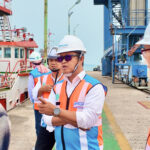
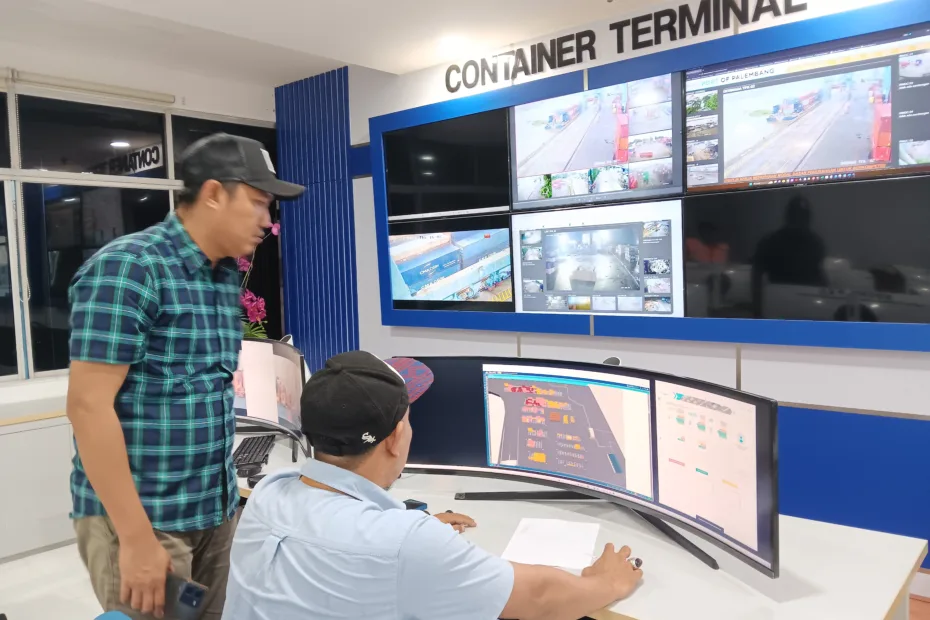
Talking to Indonesia Shipping Gazette during a visit to Palembang Port’s Planning and Control Tower on December 21, acting assistant manager TPK Palembang Miswar Mahyudin explained that all services and operation at the terminal has been running according to the TONUS system since it went live on December 11, 2023.
This web-based system, he said, is more easily accessed compared to the former system (I-TOS and OPUS) which run under application based.
“Until now it has been running according to the plan. This system more easily since it runs under web-based in which we can monitor it from private device like mobile phone,” Miswar said, adding that before it went live, TONUS had been intensively socialized to port (terminal) users.
TONUS is a system based on the latest technology that supports end-to-end services at container terminals with planning and control-based operating patterns, starting from vessel planning, berth planning, yard planning, control tower.
The system comes with several advantages such as implementing solutions on several sites in one system (multi-tenant), ease of tracing and tracking cargo in the terminal (cargo-visibility), optimizing terminal business process operations in providing cargo/container services (terminal optimizer), low investment costs with volume-based pricing and cloud-based infrastructure (low investment) as well as easy integration of data and surrounding systems (open for integration).
This system will provide various benefits, from terminal itself until customers. The terminal operating planning preparation times are more optimal with advanced ship planning and core functionality that supports port operational services. It provides benefits to customer as the system can be integrated with customer’ systems.
The implementation of OPUS is a part of the digital transformation agenda that IPC TPK – the operator of
Palembang Container Terminal – is currently intensifying. As one of the largest container terminal operators in Indonesia, IPC TPK is currently entering the integrated systemization stage (integration).

Contingency Plan Is Needed
Terminal users, though appreciating it as the Pelindo’s innovative step to go with the information and technology update and support a more efficient service, are calling for contingency plan or a back-up plan as an anticipation step in case of trouble.
“We appreciate with Pelindo (TPK) on adopting this system. In principle, we support any efforts to streamline business and to make business and service more efficient. And if this system (TONUS) is meant to fasten process of container loading/unloading and receiving and delivery to and from the terminal, all users must support it, I guess,” said Irsyad Pahlevi, Vice Chairman of Stevedoring Companies’ Association (APBMI) of South Sumatra.
But, Irsyad, who also doing business as consignee (representative of cargo owners), reminded Pelindo to prepare alternative step in case of the system is getting trouble. “Whatever the system is, one day, it will get trouble. So, alternative step for business continuity is very necessary.”
“We don’t expect the loading process, for example, is delayed or even cancelled, just because of the system failure. Therefore, a contingency plan is needed. Don’t wait for over than two hours if the system does not work,” he reminded.
In responding this, IPC TPK Assistant Manager for Planning and Operation Asep Saiful explained that the terminal had prepared its contingency plan as what they named it as BCP (business continuity plan) in anticipating it. “In case of the system error, we have prepared the solution as we call it business continuity plan.”
“So, anytime the system is down, we have formulated a staging system. Any stages have each time period until we come to a manual stage as the last action,” he said.

Supporting Productivity Increase
The adoption of the system is also expected to boost throughput at any terminals in which the system is adopted, especially the terminals with high contribution to the total IPC TPK throughput.
TPK Palembang is one of the leading contributors to IPC TPK. According to the data, TPK Palembang is the third biggest contributor to IPC TPK, after Tanjung Priok and Pontianak.
According to data, TPK Palembang throughput until November has reached 108,624 TEUs, increasing 6.73% YoY, from 101,776 TEUs in January-November 2022. It also exceeded the target (RKAP) by 5.78% which was contracted to 102.692 TEUs.
Rubber, coconut, and wood products are the top three commodities exported from Palembang.