





Digitalization is inevitable in the port and logistics business, making them more competitive in the market. EDII responds well, offering some solutions. What solutions?
Supply chains have changed over the past decades. Digitalization in the port services, logistics activities, and the related changes to the flow of goods introduce new challenges to the industry. The traditional role of ports as part of the supply chain needs to be reevaluated. Port authorities and operators must examine the performance of their ports and increase efficiency in port operations.
In addition, the increasing competition, the availability of new shipping routes, and new competitors in the logistics industry have a noticeable influence on the port performance. Maritime logistics actors need to take part in redesigning an optimal flow of goods actively. Information technology is the base, and digitalization in logistics is the key to success.
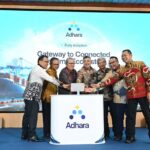
Such changes and the future direction of the ports and logistics have been confirmed by Electronic Data Interchange Indonesia (EDII), a subsidiary of Indonesia’s Leading Port Operator PT Pelabuhan Indonesia II/IPC, a pioneer company in developing Electronic Data Interchange Services (PDE) in Indonesia.

In a discussion with Indonesia Shipping Gazette, Helmi Wantono, EDII President Director, affirmed that IT has significantly affected the business and positively brought benefits.
“Digitalization has impacted what we call EODB (ease of doing business), including trade facilitation for the port and logistics business sector,” said Helmi.
Helmi affirmed that many parties have been aware of this, including the government authorities, proven by government initiatives to issue some regulations and institutions to support the adoption of digital services. He named some examples, including LNSW (Nasional Single Window Institution), SPBE (government regulation No 95/2018 on electronic-based government system), and the President Instruction No.5/ 2020 on National Logistics Ecosystem (NLE).
“Those initiatives give opportunities to logistics players and port operators to implement IT, in a bid to make the business to government (B2G) system interoperability easier,” Helmi said.
In addition to the government, the business players, including logistics providers and port operators, have massively utilized the technology trend. They have adopted further than just digitalization to shifting business proses. They have come to non-disruptive aspects, meaning that those business players have optimized the IT without leaving their core business. They have developed their own e-logistics platforms.
“We understand that they have optimized non-disruptive digitalization, meaning that they have adopted IT to make their existing business easier,” he said.
However, Helmi admitted that the digitalization the business players adopted at this time was just for their internal segment. They have not adopted it for inter-segments. “If they can develop it (digitalization) for inter-segments, it will be perfect for their customers,” he said.
“But, in general, all business players, including logistics providers and port operators, have been aware of digitalization,” Helmi said.
Echoing this, EDII Division Head of Business Development Budi Setiawan explained that after the issuance of the Inpres 5/2020 on NLE, the ecosystem-based platform in logistics and port affairs had continued to increase. EDII, he said, has collaborated with some parties to develop those platforms.
“The online logistics platform that we developed at this time has been integrated with NLE, in which it has connected with the three container terminals handling export-import in Tanjung Priok,” he said.
“Even we have collaborated with some global logistics platforms,” Budi said, adding that EDII has collaborated with a member of PAA (Pan Asian e-Commerce Alliance) to set up an interconnectivity platform for cross-border services.
These platforms will benefit business players, he said. “Minimize data entry process and end-to-end cargo tracking visibility.”
Solutions for Digital Services

EDII has offered several products in relation to the port services but can be divided into some categories. EDII Department Head of Marketing & Partnership Department, Joko Widhi, explained that EDII’s services are categorized under Terminal Operation Solution, Marine Operation Solution, IoT and Operation Monitoring Solution, Port Commercial Solution, and Digital Office Solution.
The Terminal Operation Solution is developed in the form of managed services in which EDII provides its technology and engineer support. This solution includes EDI Services (port data interchange), i.e., container terminal data interchange with related customs stakeholders, quarantine, shipping lines, warehouses at lane 2, and behandle terminal. Second, TPS Online Interface, and third, Behance Operation System (BOS).
The Marine Operation Solution is a solution for the marine operation sector with expected port operators and shipping line users. Joko Widhi explained that this product is in line with the International Maritime Organization (IMO)’s Convention on Safety of Life at Sea (SOLAS), in which vessels and offshore drilling facilities should periodically inform their position through equipment Long Range Identification Tracking (LRIT). “EDII plays as LRIT recognized ASP (Application Service Provider) for certificating conformance test dan equipment test,” Joko Widhi said. In addition, relating to this solution, EDII is also experienced in implementing AIS Monitoring systems at some PT. Pelindo II / IPC ports.
The IoT and Operation Monitoring Solution is related to the technology application toward an intelligent port by utilizing automation technology and the Internet of Things (IoT). EDII is experienced with this solution as it has applied Remote Crane Management & Monitoring Systems (RCMMS), Autogate System and Auto Tally System, and electronic seal (e-seal).
In the commercial sector, EDII has Port Commercial Solution. EDII has experience in developing portal e-commerce, i.e., CFS Portal. This CFS (Container Freight Station) Portal remains an initiative to help stuffing/stripping for LCL (less than container load) containers and ex-LCL cargoes are easier. In addition, relating to this solution, EDII has also developed an integrated billing system (under a project-based scheme) for TPK Koja Container Terminal and Non-Container Terminal Banten.
The last product EDII offered to customers at this time is Digital Office Solution. This product is a solution for the new normal era amid the pandemic covid-19 outbreak. EDII has launched the HadirKoe Application, a web and mobile application as a solution for monitoring the attendance of office staff and workers. Hadirkoe will record the daily presence of office staff and report staff daily activities, both those who are WFO (work from the office) and WFH (work from home).
“All these products have been adopted by some logistics business players and port operators. For example, our TPS Online Interface product has been applied by both container and non-container terminals. The container terminals of IPC TPK in Tanjung Priok, Panjang, Palembang, and Pontianak, and NPCT1 (New Priok Terminal Container 1) have applied it. While the IPC Banten is the non-container terminal that has adopted this product,” said Joko Widhi.
“This product has also been adopted by some TPS at some airports, including Gapura Angkasa, Garuda Indonesia, Angkasa Pura Kargo, JAS, Bollore, DB Schenker, and others more,” he further said. Another example of an EDII product that has been applied is e-seal IS3. Some leading logistics companies of Pantos have adopted this product, including Pertamina Drilling Service, Sankyu, Pacific Logistics, CJ Logistics, and some PLB (bonded logistics centers) in Semarang and Surabaya.
Benefits for Customers

Budi Setiawan and Joko Widhi explained that customers would get many benefits from these EDII products, but they generally named three main benefits. First is total cost ownership. Most EDII products are sold under the OPEX scheme. Users do not need large investments for it as EDII offers software as a service (cloud). There is no need for users to invest in IT infrastructure and software development. Users will only be subscribers under ‘pay as you go.’
The second is operability. By adopting these products, users can operate 24 hours a day and seven days a week (24/7). “Let us say our Behandle Operation System (BOS) product. Since this product integrates the information from customs, quarantine, and the terminals, the Behandle Terminal can operate 24/7,” said Budi Setiawan. The third is efficiency. These products will make users’ business processes more efficient since they are paperless and non-manual anymore.
Challenges and Future Opportunities
Budi Setiawan and Joko Widhi affirmed that the users are now more aware of the technology. For EDII, this is a challenge and opportunity for its future business. “Sometimes, our customers’ expectations are more than we offer. This is absolutely a challenge and opportunity for us to continue developing and upgrading our products,” said Budi Setiawan.
EDII, said Budi Setiawan, is always ready to customize its products with customers’ expectations or integrate them with customers’ internal systems.
As digitalization in logistics and port businesses is going massive, as proved by many e-logistic platforms launched, EDII will continue to develop products that will increase the values of those platforms. “We are ready for synergy and collaboration with them,” Budi Setiawan said.
EDII is now continuing to develop new products, including APILOGY products, an API-based platform, Robotic Proses Automation (RPA), Cross Border Service, and Machine Learning. “The RPA will be used for smart scanning document without entry process, while the Cross Border Service will be used to connect with some regional platforms like GeTS, Dagang Net, and other PPA members,” Budi Setiawan
This article was published in ISG Print Magazine March 2021 Edition.