



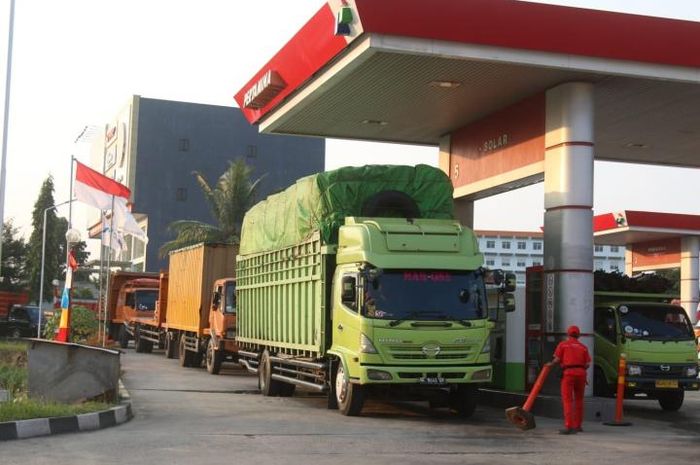
Logistics business actors stated that the increase in national logistics costs was unavoidable due to the domino effect of subsidized diesel fuel (BBM), which experienced an increase.
This is because most national logistics players, including truck operators carrying goods and logistics, have been using subsidized fuel due to high market/consumer demands for low logistics costs.
“We understand that there is a potential increase in logistics costs, especially those related to goods truck and logistics activities, due to the increase in subsidized diesel fuel. However, what percentage of the ideal amount of the increase in freight rates must be negotiated together, “said Chairman of the Indonesian Logistics and Forwarders Association (ALFI) DPP Yukki Nugrahawan Hanafi, quoted from logistiknews.id on Sunday (4/9/2022).

He explained that the direct effect on the fuel component in the formula for calculating the cost of land transportation (trucking) represents 35-40%.
“So any coefficient of the increase in fuel prices will have a big impact,” said Yukki.
Meanwhile, indirect effects related to other costs, such as the price of maintenance and spare parts, will also increase due to indirect costs of production and delivery of spare parts to entrepreneurs/truck owners.
Logistics Performance
Yukki said that the impact of the increase in subsidized fuel prices would have the potential to suppress national logistics performance.
“Logistics performance will be under enormous pressure because I mentioned earlier that the fuel component in land transportation is quite high. Moreover, the distribution of goods by land transportation modes nationally is still dominated by land transportation,” he said.
On the other hand, said Yukki, not to mention the market response of transportation users, which is a free market, as if they don’t care and impose price shifts due to the increase in fuel prices to transportation service providers.
“This is because they think that the basis for the increase is only the price of fuel as a direct result,” he said.
According to Yukki, the condition of the logistics industry amid the current economic recovery momentum is quite good, the volume has gradually increased, and mobility is looser.
According to Yukki, the condition of the logistics industry amid the current economic recovery momentum is quite good, the volume has gradually increased, and mobility is looser. It’s just that the logistics industry still needs government support to ensure the plan can be realized. For this reason, ALFI sees the need for certainty regarding the availability of a non-stop fuel supply nationally.
The phenomenon of queuing for fill fuel at gas stations that we have seen lately is quite massive and concerning and impacts logistics performance because the productivity of capital goods (trucks) is not optimal.
“Supply chain talks about reliability and sustainability, which are predictable according to forecasts, as well as in terms of fuel supply and demand,” he explained.
ALFI Initiation
The supply and demand imbalance in subsidized diesel fuel for goods transportation and logistics has become a severe problem for the regions.
Said Yukki, in areas experiencing problems, ALFI has initiated to take a role and innovate in helping PT Pertamina (Persero) to solve this problem.
ALFI also encourages the realization of a national logistics ecosystem as a long-term solution to overcome logistics problems as part of the supply chain.
According to Yukki, the commitment to the logistics ecosystem in the efficiency of logistics services is a benchmark for the effectiveness of logistics performance and other industrial support.
“So our business depends on other industries that use our services. Efficiency on the part of our producers as consumers means efficiency in our business. So it is necessary to have multiple sectors and institutions to ensure a sustainable logistics business. For example, not only the Ministry of Transportation but also the Ministry of Trade, Ministry of Industry, Ministry of Finance, etc.,” explained Yukki.
Yukki also said that the domino effect of rising subsidized fuel would raise the price of consumer goods, and this is the hardest thing, especially since inflation is a particular concern for the government to keep under control.
“However, ALFI still believes that the projected growth of the logistics business in 2022 and 2023 will continue to grow positively because the strength of domestic consumption still supports it,” said Yukki.