






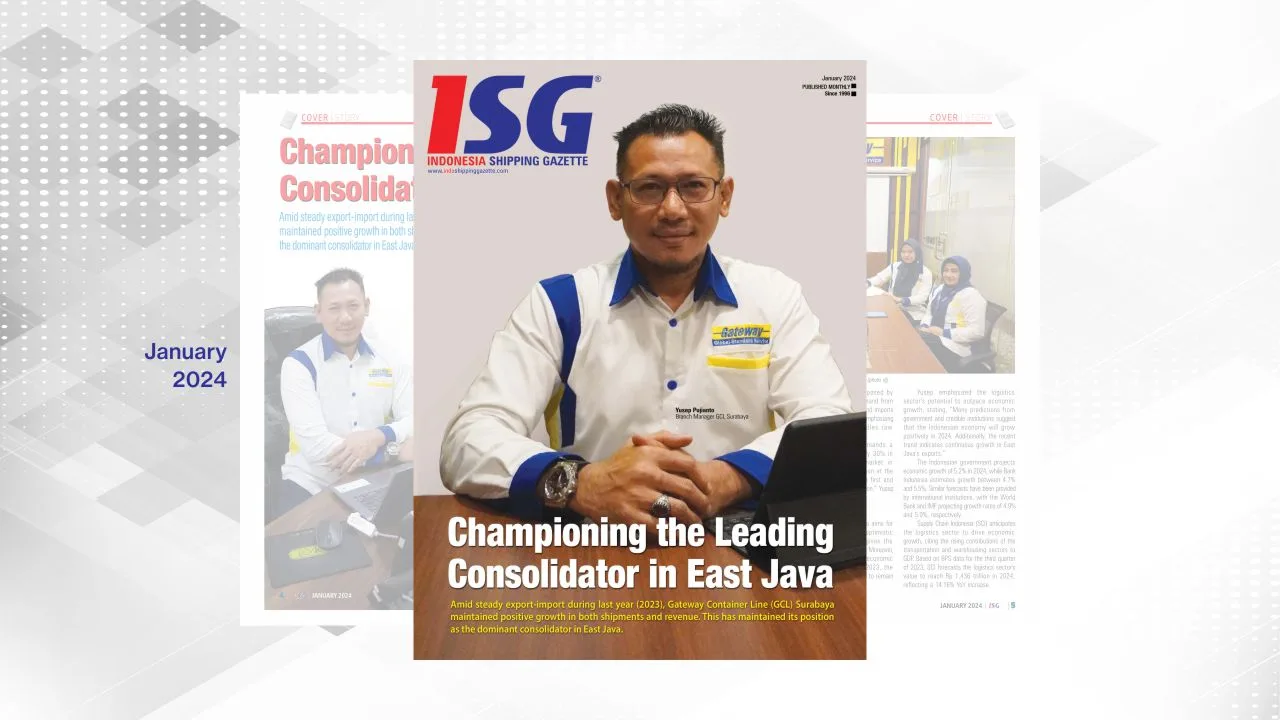
Amid steady export-import activity during the last year (2023), Gateway Container Line (GCL) in Surabaya maintained positive growth in both shipments and revenue. This has reinforced its position as the dominant consolidator in East Java.
For Gateway Container Line (GCL), a leading national consolidator, East Java (Surabaya) plays a pivotal role in overall corporate performance. The branch ranks as the second-largest contributor to total corporate revenue, following Jakarta. This is evident as East Java remains one of the provinces making a significant contribution to the national economy, consistently ranking in the top three in terms of export value.
According to the Statistics Indonesia (BPS), although the export value in 2023 was lower than that in 2022, East Java maintained its position as the third-largest contributor to national exports and imports. The province’s export value from January to October 2023 reached US$18.26 billion, accounting for approximately 8.51% of the total national value of US$214.41 billion. This maintained the province’s standing as the third-largest contributor, following West Java with US$30.76 billion (14.35%) and East Kalimantan with US$23.48 billion (10.95%).
In September 2023, East Java’s exports amounted to US$1.88 billion. While this marked a 10.47% increase from August, it represented a 9.90% year-on-year decline compared to September 2022. However, exports and imports rebounded starting in October. Exports in October 2023 reached US$2.10 billion, an 11.55% increase from September and an improvement from US$1.93 billion in October 2022. Meanwhile, imports in October totaled US$2.26 billion, an 8.62% decrease from September 2023’s figure of US$2.48 billion.
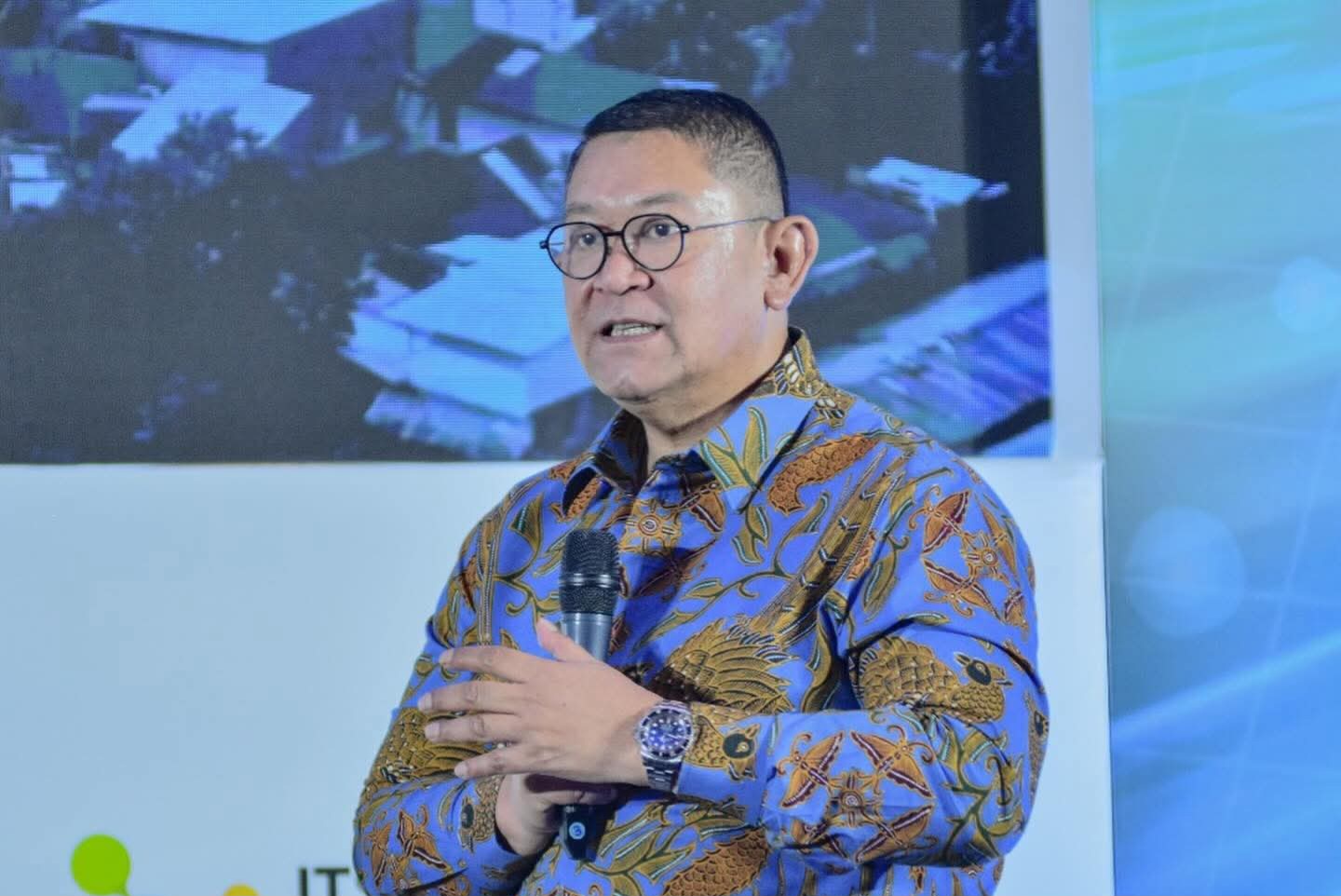
Despite sluggish export-import activities, particularly from January to September, Gateway Surabaya continued to experience positive growth. In a recent discussion with the Indonesia Shipping Gazette, Yusep Pujianto, the Branch Manager of Gateway Container Line Surabaya, revealed that Gateway’s shipments grew by 15% during the year, driving a 20% increase in revenue. “In general, the export-import market in East Java remained steady in 2023. However, for Gateway, both exports and imports grew positively,” Yusep remarked, highlighting that Gateway managed over 11 containers per week, comprising 7 TEUs for exports and 4 TEUs for imports. He added, “Mostly, these are console cargoes, with a composition of 60% exports and 40% imports.”
“From 2021 to 2023, we have consistently witnessed growth,” he added.
“Despite the challenges posed by the Covid-19 outbreak, the demand from our customers for both exports and imports remained strong,” Yusep noted, emphasizing that Gateway primarily handles raw materials.
Gateway Surabaya commands a market share of approximately 30% in the console export-import market in Surabaya, maintaining its position at the forefront. “We consistently rank first and occasionally second in consolidation,” Yusep affirmed.

Targeting a 9% growth in 2024
Gateway Surabaya remains optimistic about achieving this goal, buoyed by the positive trends observed in 2023. Moreover, despite projections of slower economic growth in 2024 compared to 2023, the Indonesian economy is expected to remain positive.
Yusep emphasized the logistics sector’s potential to outpace economic growth, stating, “Many predictions from the government and credible institutions suggest that the Indonesian economy will grow positively in 2024. Additionally, the recent trend indicates continuous growth in East Java’s exports.”
The Indonesian government projects economic growth of 5.2% in 2024, while Bank Indonesia estimates growth between 4.7% and 5.5%. Similar forecasts have been provided by international institutions, with the World Bank and IMF projecting growth rates of 4.9% and 5.0%, respectively.
Supply Chain Indonesia (SCI) anticipates the logistics sector to drive economic growth, citing the rising contributions of the transportation and warehousing sectors to GDP. Based on BPS data for the third quarter of 2023, SCI forecasts the logistics sector’s value to reach Rp 1,436 trillion in 2024, reflecting a 14.16% year-on-year increase.
Accelerating Domestic Market Penetration
To achieve its target, Gateway Surabaya plans to expand its operations to the domestic market, complementing its existing international market presence. Leveraging its two primary hubs in Singapore and Hong Kong, where it collaborates with two agents at each location, Gateway Surabaya is well-positioned for global expansion. Furthermore, its representative in Pusan, South Korea, enhances its capability to dominate the shipment of LCL cargoes between Indonesia and other Asian countries, facilitating intra-Asia trade.
“We have successfully developed our services for the international market, serving trade routes from Surabaya to various global destinations and vice versa. Our current focus is on the domestic market, particularly in East Indonesia. It’s encouraging to see Surabaya’s Tanjung Perak Port emerging as a hub for trade in East Indonesia, presenting an excellent opportunity for Gateway Surabaya,” commented Yusep.
Over the past few months, Gateway Surabaya has initiated its foray into the domestic market by offering FCL, LTL (less than truckload), and LCL services. Looking ahead to 2024, the company is poised to intensify its efforts in the domestic market. “Our primary objective for 2024 is to establish Surabaya as the gateway hub for our services in East Indonesia,” Yusep added.

Go-digital Consolidator
Yusep emphasizes the pivotal role of the logistics sector in driving economic growth and its potential to bolster other industries through enhanced efficiency and effectiveness, achieved via human resource development and technological innovation.
Recognizing the transformative impact of rapid technological advancements on the logistics sector’s competitive landscape, Yusep stresses the imperative for established logistics service providers to embrace digitalization. “Our commitment lies in continuously enhancing our services through the integration of advanced technology and fostering human resource development. We aim to provide our customers with efficient and user-friendly digital services, thereby optimizing their experience,” Yusep explained.
To this end, Gateway Surabaya has developed a web-based system that streamlines communication, facilitates document processing, and enables customers to track their shipments seamlessly. “Our digital platform has significantly simplified communication, streamlined document processing, and empowered customers with the ability to monitor their shipments in real-time,” Yusep highlighted.
Yusep expressed his pride in Gateway Surabaya’s digital transformation, affirming its commitment to further refining its systems in alignment with technological advancements. “As we continue to evolve, we remain dedicated to enhancing our expertise in digital logistics and further strengthening our human resources,” he concluded.
This article was published in ISG Print Magazine January 2024 Edition.