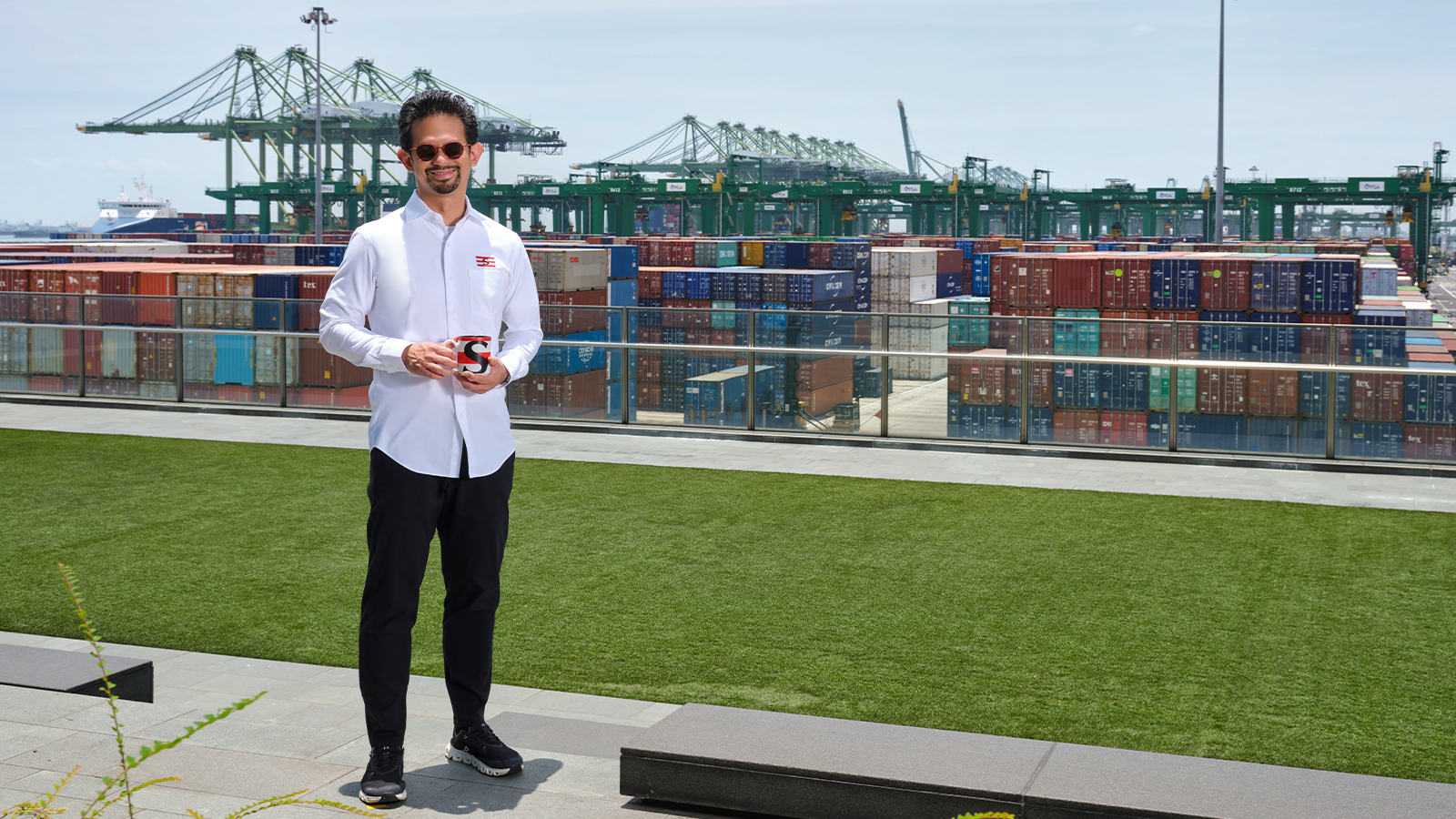






Strong demand in the shipping and logistics market predictably will continue until next year, but disruption in this sector will parallel the projected market growth. Erry Hardianto, Senior Director and Area Managing Director for A.P. Moller – Maersk Indonesia, shares his views and steps in securing the supply chain.
This year, the shipping industry until the third quarter (Q3 2021) was marked by some records. It created records in demand, capacity supply, high freight rates, carriers’ revenue and profits, and record in the low idle fleet. It was good for this industry. However, at the same time, the industry also created some negative records in delays, low reliability, and transit times.
The record in demand has benefited shipping lines, so has the ports. The report said, almost all global leading ports enjoyed an increasing throughput until September this year. Like the ports, international shipping lines also enjoyed volume growth they handled during the three quarters (Q1-Q32021) this year. US ports are reported with the highest growth, in which Port of Los Angeles enjoyed the highest by 26% for the period.
In parallel with the volume growth, shipping lines harvested high revenue and net profit for this year, thanks to the high freight rate. However, they have to spend high cash for operating costs due to exponential increases in operational cost, bunker cost, and charter rate.
Based on the results of carriers that report their earnings, New York-based consultancy Blue Alpha Capital has calculated combined earnings for the liner industry in Q3 reaching $48 billion and a nine-month (January-September 2021) cumulative net result of $105 billion. This nine-month result even exceeds the total profit made by the companies over the past five years.
But, in parallel with this potential market growth and positive financial statement, many problems occurred within the industry during the period, totally disrupting the supply chain activities. Container and vessel space shortages, port congestion, skyrocketing freight rates, longer waiting time are the top issues that have become corridor talks among business players.

In discussion with Indonesia Shipping Gazette, Erry confirmed and amended those conditions, saying demand grew up fantastic. Still, at the same time, disruption due to the covid-19 outbreak also affected the shipping operation performance.
The current surge in demand has occurred since early this year. “Demand is already quite high from the beginning of the year, but problems, let us say port congestion and longer waiting time, are also there,” said Erry.
Erry names examples of United States market, the surge in demand for goods in the US has reached double-digit, over 10%, compared to the pre-pandemic period in 2019. This figure will be higher when compared to the statistics during the initial period of the pandemic in 2020. “The surge is so fantastic. US demand grew double-digit from the baseline of 2019,” he explained.
Some combined factors triggered this anomaly. One is the covid incentive from the government to trigger people purchasing power and diversion of spend from services into goods. “The surging demand in the US is caused by, among others, the government covid related incentive that increases the community’s purchasing power. In addition, most of the community’s budget for services, such as tourism, was diverted for goods shopping instead due to heightened people movement. Let’s say if earlier we spent part of our income on services such as tourism or holidays but Covid has restricted people movement and closed down these facilities. The reduction of spending on services, on the other hand, increases our ability to spend on goods,” Erry explained.
Though they get benefited from this market growth, shipping lines also faced quite complex problems. “The problems are mostly caused by the increasing demand of global trade on the one hand, while on the other hand, facilities, especially trucking tasked to deliver containers at the port of destinations, have not worked at maximum yet due to the pandemic policy (lockdown). This results in port congestion and longer waiting time for vessels, thus finally disrupting the supply chain,” explained Erry.
Erry gives examples of US ports congestion resulting in a longer waiting time from 10-14 days. Data says the two US ports of Loss Angeles and Long Beach recorded 79 container vessels waiting to berth at the two ports on 20 October.
Congestion at some global leading ports/terminals has seriously downgraded shipping reliability. The latest figures show that just 34.3% of vessels arrived within one day of their scheduled arrival time in September. The average delay across the global fleet was more than a week.
“Like a perfect storm, this has created big disruptions on the overall network of the supply chain, far beyond the container shipping industry. These disruptions added a lot of inefficiencies to nearly all fronts of stakeholders. It increases the service and operating costs and congestion added to the current imbalance between supply and demand,” he said.
“Even the current issue of container and ship space crisis is mostly driven by the recovery in the global economy, rather than the issue of shortage of containers for export,” he said.
Erry affirmed that this high demand had triggered this year’s high freight rate, but it is not a single factor. “It is clear that the main factor of the high freight rate is supply and demand, but it is not a single factor. There are other factors,” he said.
Erry named other factors, including higher operational cost, higher cost for loops since a route requires more vessels to secure weekly service, and higher bunker cost.
In addition to the supply and demand factor, the increasing freight rate is also triggered by, first, higher operational cost, second, extra cost created by a loop that deploys more vessels to secure weekly service, and third, higher bunker cost.
“Shipping operational cost has skyrocketing. The said that the charter cost has been increasing by more than 400%,” he said.
“The congestion at the port makes waiting time much longer even until 14 days in US ports has forced shipping lines to add more vessels deployed for a loop to secure weekly service. This does not add capacity, but it creates extra cost,” he said.
“Shipping lines have to spend more cash for bunker as the oil price has been increasing,” he said.
Until Q2 Next Year
Erry admitted this strong market and the disruption within this industry will likely continue until next year, at least until the second quarter (Q2), in view of some factors. First, the effect of this pandemic will continue.
“No one knows when this pandemic and its effect will end. If we still see some form of movement restriction, we will see a subsequent impact on the availability of labor. If this happens, it will prolong the current congestion at ports and hinterlands.
Second, high demand will likely continue into some part of 2022. Demand for goods in the US will like to continue to grow at a healthy level.
Erry affirmed with the Maersk Headquarter market outlook for this year. Maersk Headquarters sees a global market in Q4 will be the same as Q3, and Q1 of 2022 is projected to be more or less the same as Q4 2021, with notes that the situation is very dynamic, highlighting the abnormality of the current situation.
Maersk sees a strong global GDP for 2022, leading by expectations of a robust CapEx cycle, strong demand, rising wages, and cheap capital. Inventory replenishment will support goods trade well into 2022, and the channel shift to e-commerce is likely to keep pressure on outbound logistics capacity.
But risks to the outlook were growing due to rising prices and a reduction in government financial support challenging the global economy and threatening to erode demand.
On the other hand, Erry also warns the disruption in the supply chain will continue until next year, as in the early year, there will be peak season of the Chinese Lunar New Year. “High demand on one hand and port congestion and vessel delays, on the other hand, will still be driven factors of the supply chain disruption,” he said.
He warned that port disruption would continue to be a factor, with congestion still a significant concern.
He also emphasized that this causes pressure on space availability but also causes pressure on schedule reliability. “The supply chain is like a chain. When one link in the chain has a problem, it affects the other links. When many ships are late to return from destination countries to Asia, it will also put pressure on supply chains in Asia,” he said.
Steps to Secure Supply Chain
But, he expects the situation (supply chain disruption) will be better next year (compared to this year), following some key steps taken by shipping lines.
“There is evidence to say the equipment situation has been starting to improve as we have continued to in-fleet containers and get more empty equipment back to Asia,” he said. But admitting that there are still shortages in some locations, but the situation has improved.
Erry affirmed that the newly built would serve the market sometime next year, but it does not automatically help the market. So, what does Maersk do to eliminate some of the pressure? Erry suggests some steps that Maersk has taken since this year.
First, MAERSK relocated vessels to the routes with high demand from the routes with lower demands. “That what we have done in Maersk,” he said.
“These vessels were being re-allocated to maintain the weekly loop on highly congested corridors, like Asia-US route. Under normal circumstances, one loop between Asia and the US will normally require five vessels. However, with the current congestion and long waiting time at ports, eight vessels would need to do the same weekly service. So even though we added more vessels, the overall capacity is not much changed,” said Erry.
“This is what we do to prevent further disruption in shipping and supply chain. All vessels that are seaworthy to sail have sailed,” he said.
Second, MAERSK introduced a policy that all vessels sailing back to Asia should be full in TEU profile but not full in weight profile. “Any vessel coming back to ASIA should reach TEUS capacity before weight capacity,” Erry said. “This helps to speed up the return of empty container back to ASIA, where they are mostly needed and help support ASIA export.
This is however not without consequences. The obvious one is reduced acceptance and delay of import cargo.”
“We have taken these two steps and they have run according to the plan,” he said.
This article was published in ISG Print Magazine December 2021 Edition.