






Facts in the first two months (January-February) indicate that the shipping business will pass this year with many uncertainties, forcing shippers/cargo owners to sign long-standing contracts under high freight rates to secure their supply chain. But, container carriers will predictably enjoy another year with a profit record as they benefit from a higher (spot) freight rate, higher contract freight rate, and higher volume demand.
Ocean freight rates are expected to remain high in 2022. Recently, the SCFI Index has surpassed the 5,000-point mark for three weeks. Thanks to this trend, contract freight rates are expected to reach an all-time high in 2022. In addition to high freight rates, there are also active discussions about signing multi-year contracts (up to three years). Shipping companies will take the initiative in negotiations to ensure their long-term profitability.
.
On the other hand, there is a fear that the employment contract negotiations with the International Longshore and Warehouse Union, which will expire in July 2022, are likely to be set back, casting another shadow on the normalization of the supply chain. The overall analysis is that uncertainties inside and outside the industry and current supply chain problems cannot be resolved in a short period. Based on this analysis, the forecasts continue to assert that the profitability of shipping companies in 2022 will increase more than in 2021.
It’s safe to say that virtually no institutions or experts predict that the port situation in the United States will normalize within the next few months. While imports remain strong ahead of the Chinese New Year holiday, about 800 people at the port of LA/Long Beach (the biggest import gateway to the US), or 10% of its daily workforce, are unable to work due to confirmed COVID-19 cases, quarantine or waiting for test results. As the unloading of cargo is disrupted due to a human resources shortage, the already-strained operation of the ports becomes even more difficult.
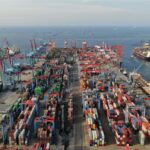
On January 6, it was reported that 105 container ships were waiting outside the harbour to be assigned their berths at the LA/ Long Beach port. On January 6 of last year, the number of vessels waiting was 32. According to the Terminal Congestion Index by Sea-Intelligence, a shipping analysis agency, the Terminal Congestion Index for North American regions in January was 40, up 60% from the index of 25 in the same period the previous year.
China also sees difficulties. Ahead of the Beijing 2022 Winter Olympics opening in early February and the Chinese New Year holiday, confirmed cases of the Omicron variant are occurring in major port cities in China, including Tianjin and Dalian. As the Chinese government’s ‘zero-COVID’ quarantine policy becomes increasingly strict, concerns about disruptions to the global supply chain are increasing.
Ningbo, the world’s third-largest port in cargo throughput, and Shenzhen, where Yantian, the largest port in South China, is located, are also in a difficult situation. Logistics flow has slowed down due to delays in delivering and collecting containers, cargo loading, and ship departures due to the strengthening of quarantine measures for truck drivers and the ban on inland transportation in some sections.
Europe is also experiencing a workforce shortage as major countries in the region have tightened their lockdown measures to prevent the spread of COVID19. Accordingly, the waiting time for berthing of ships has lengthened, and the yard utilization ratio of major port terminals exceeds 100%. The Terminal Congestion Index in Europe reached an all-time high of 49 at the end of January. Sea-Intelligence stated, “The congestion in major European ports, ongoing since 2021, shows no sign of easing. Port congestion has a negative impact on a ship’s punctuality and available capacity, fueling an increase in freight rates in the Asia-Europe section.”
Industrial sites, including trucks, warehouses, and factories, also suffer from a severe workforce shortage. The shortage of truck drivers, the core of the logistics network that accounts for more than 70% of goods distribution in the United States, is serious. According to the American Trucking Association, about 80,000 more truck drivers are needed to ensure smooth cargo transportation. The Association estimates a shortage of about 60,000 truck drivers before the pandemic.
Workers are searching for safer and better conditions as the work environment worsens due to COVID-19, intensifying the labour shortage that truck companies already face. While the number of new unemployment claims in the US recently reached its lowest level since the pandemic, the job market is showing a marked recovery, with job openings approaching an all-time high.
In Tianjin, China, the Toyota plant was shut down for two days (December 10-11) due to mandatory COVID-19 testing for all 14 million citizens. Shenzhou International Group, which supplies products to Nike, Adidas, and Uniqlo, has also suspended some factories in Ningbo due to the government authorities’ quarantine policy.
Factories in southern Vietnam’s manufacturing centre record a factory utilization rate of around 65-80% due to a lack of manufacturing human resources. Many workers who had returned to their hometowns during the COVID-19 crisis have not yet returned.
Demand High, Contract Rate Much Higher
Sea-Intelligence CEO Alan Murphy said, “The root cause of port and inland congestion is the constant demand from American consumers. To solve the problem, changes in demand must begin, but there are no signs of a slowdown in imports of consumer demand yet.”
Los Angeles Port Authority Commissioner Gene Seroka expects import volumes to increase in the second quarter as retailers scramble to replenish their inventory. And states, “According to retail industry sources, shipments for peak season goods will begin from late spring, as shipping on North American routes is expected to be tight in 2022.”
According to data from the U.S. Census Bureau, despite the continued import boom, the U.S. retail industry’s inventory to sales ratio stood at 1.09 as of the end of November last year, its lowest level over the past decade when the average was in the 1.4 to 1.5 range.
On the other hand, it was revealed that the conversion of consumption expenditures from goods to services has not been as strong as expected. According to Bank of America’s credit/debit card tally data, American consumers still spend a lot on furniture, housing renovation, and miscellaneous goods. As of the first week of December 2021, the number of card payments for these products increased 34%, 39%, and 17%, respectively, compared to pre-pandemic levels in 2019.
As demands for annual contracts increase, freight contract rates soar as well. Currently, negotiations for yearly contracts for the US-Asia route for 2022 are in progress. Although the agencies providing this information have calculated different bid prices, the average is very high compared to 2021. According to JOC, a shipping and logistics magazine, some of the annual freight contract negotiations for the AsiaNorth America route have been completed, with one mid-sized shipper signing a contract at a level more than double that of 2021. Previously, the JOC predicted that the freight contract rate would be signed in 2022 at an increase of $3,000/FEU for the U.S. west coast and $4,000/FEU for the U.S. east coast compared to the previous year.
The analysis of Xeneta, a company that provides container freight rate information, is no different. Xeneta said, “To respond to uncertain market conditions, more shippers are hoping to expand their annual contracts with shipping companies. With numerous factors to consider, contracted ocean freight rates for 2022 will reach an all-time high.”
Philip Damas, a senior consultant at Drewry, a shipping analyst firm, said, “Shippers’ desire to avoid uncertainties in the timely transportation market is high. In general, contracted ocean freight rates in 2022 will rise by at least 60% from 2021 levels.”
Meanwhile, some shipping companies are proposing two to three-year multi-year contracts at a rate lower than a one-year contract. There are cases where they negotiate by including terms of use of logistics services other than the sea section in the contracts. In addition, some analysts say that in most cases, granting shippers long-term demurrage/detention free time (minimum 15 days, maximum 30 days) will disappear as they are suffering from severe port congestions due to container congestions.
This article was published in ISG Print Magazine March 2022 Edition.