




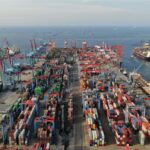


Container shipping has been playing key role in global trade for more than seven decades, since 1950s. But, amid the pandemic it faced many challenges, calls for break bulk to play wider role in the trade activities.
The break bulk sector has a long history closely connected to trade. It took until the 20th century for things to change. Before the Second World War, all transport was done in the form of break bulk and could be described as general cargo.
After World War II, some specialization appeared with dedicated merchant vessels designed for specific cargoes. And, since the 1950s, shipping model started a massive change, characterized by a shift from man load to unit load and bulk cargoes.
At one side of the spectrum, bulk commodities (powders, grains) were increasingly carried by specialized bulk vessels. On the other side, there was a clear trend for general cargo to merge into unit loads such as pallets and containers. The cargo unitization went hand in hand with the development of specialized terminal equipment (e.g. specialized quay cranes, forklifts, terminal tractors, straddle carriers, reach stackers, RMGs, RTGs) and specialized ships (e.g. container ships and RoRo ships). Forklifts, tractors, and other mechanical equipment have been around for more than seventy years.
The general cargo was increasingly handled in container ships or RoRo ships. These developments resulted in a spectacular rise in the productivity of labor and port facilities. Vessel turnaround time for a given cargo capacity decreased significantly while far fewer workers were needed.
Technology brought new requirements in terms of the skills of the workforce. Up to the late 1950s, dock work basically involved unskilled work requiring little training, except for the operation of the mechanical devices, which at that time accounted for around 10% of the work. Dockworkers were mainly used to handle various bags, and other man loads manually. The multi-skilled nature of dock workers was limited to handling a broad variety of loads, such as bags, bales, crates, and drums.
The current state of the break bulk market cannot be understood without the impacts of containerization. In 1956, the launching of the first containership, the Ideal X, is often considered the beginning of containerization. In the early years of container shipping, vessel
capacity remained very limited in scale and geographical deployment, and the ships used were converted general cargo ships or tankers.
Shipping companies and other logistics players hesitated to embrace the new technology as it required significant capital investments in ships, terminals, and inland transport. Container shipping developed rapidly due to the adoption of standard container size in the late 1960s and the awareness of industry players about the advantages and cost savings resulting from faster vessel turnaround times in ports, the reduction in the level of damages and associated insurance fees, and the integration with inland transport modes such as trucks, barges, and trains.
Goods that can easily be stuffed in a container have been massively containerized, partly because of relatively stable and even declining container shipping costs and a growing number and availability of containers in transport markets worldwide. However, temporal shortages of containers (as reported by market players during the COVID-19 health crisis) and specific container sizes can hamper further containerization in some markets.
Challenges
The pandemic covid-19 outbreak has disrupted many economic activities, including in the sector of transportation, logistics, supply chain, shipping, etc. Coming to the fourth quarter last year (2020) and predictably would continue in the first quarter this year (2021), the dominant issues in these sectors include the container shortage, high freight rate, and potential congestion at some ports.
This is a clear and acute problem, but it is also a problem that can no longer be seen as “new.” The operational challenges within container shipping have now persisted for half a year, and they are seemingly nowhere nearer to getting resolved. If anything, they mainly appear to be getting worse.
The situation is one of intertwined bottlenecks of port congestion, vessel shortages, equipment shortages, chassis shortages, rail shortages, and truck shortages. Perhaps we should take to calling it the “everything shortage.” On top of that, shippers are attempting to service a massive boom in consumer demand for imported goods.
In essence, there is not a shortage when purely measuring the number of containers and ships available versus the amount of cargo in need of shipping. The problem is that it now takes much longer to move the cargo — and the equipment — which in turn soaks up large amounts of capacity.
In its recent report, Drewry, a shipping consultant and observer, listed some main factors that had created and would potentially create problems in shipping industry.
First, tight capacity management and increased blank sailings by carriers: The pandemic-led lockdowns disrupted global trade. Across the supply chain, container shipping alliances were the fastest to respond – curtailing services on certain routes or cancelling (blanking) port calls.
This has disturbed the containers demand and availability equilibrium at ports.
Second, unexpected increase in demand: 1) the sudden spike in container volumes to meet the higher demand following the reopening of economies after lockdowns; 2) the usual pick-up in demand before the holiday season; and 3) front loading of orders by importers to safeguard themselves from any supply chain disruption that could be triggered by a second wave of infections (which has already become a reality in some parts of the world), have led to congestion.
Third, cost management tactics adopted by ports to combat the impact of COVID-19: Container ports deployed cost management strategies to save the bottom line from the COVID-19-led decline in revenue. However, these strategies have resulted in unwarranted consequences once the operating environment improved. In Felixstowe (UK), for example, the decision to let go the contract workers to lower the cost has left the port underprepared for a steep recovery in volumes that started in 3Q20 and has resulted in the current congestion at the port.
Fourth, ripple effect of congestions at nearby ports: The heavy congestion at Felixstowe (UK) has not only overburdened other ports in the UK (Southampton) but also ports of northern Europe (Rotterdam and Zeebrugge) as carriers have stopped calling Felixstowe and are instead unloading containers at nearby ports.
Fifth, increased health measures adopted to safeguard against COVID-19 infections: Several ports in China are facing congestion as the country mandated COVID19 checks primarily to stop the spread of the infection.
Break Bulk, Multipurpose More Promising
With the massive expansion of the container shipping industry in the last seven decades, it can be erroneously assumed that break bulk or conventional general cargo is a declining cargo segment. But, in reality, this is not the case. The break bulk sector has not disappeared but changed in nature, becoming a specialized sector, handling the goods which are too challenging to transport in containers or where containerization does not represent a valid and cost-efficient proposition.
Even, the break bulk sector is poised for “significant growth” in 2021 as upward pressure on freight rates and a resurgent wind energy sector propel demand, according some sources.
Analysts and business players predict that rising prices for container shipments will affect the multipurpose market going forward and lead to an increase in utilization. “Looking at the market conditions, we see – besides lots of uncertainties – a rising demand in tonnage, especially in renewable projects. However, the current market challenges require us to be as flexible as possible with our 2021 planning,” said Lars Feller, global vice president of dship Carriers
Alongside a return of demand from oil and gas projects, the firm foresees significant potential in the wind sector as investor appetite for renewable projects grows.
“The dimensions and weights of windmill blades, towers and nacelles have grown significantly over the last few years, and therefore not every MPV ship is now suitable for loading such parts. This cargo should therefore tie up more capacity on the larger ships reduce free capacity in the market and, consequently, rates could increase,” Feller’s firm states in its Q1 Market Report.
“The emerging trade imbalances of shipping volumes challenges us in terms of obtaining return cargo. Unpredictable factors like the pandemic, the recovery of the global economy and developments in specific industries such as oil and gas are still to be faced,” Feller concluded.
Promising market will also be enjoyed by another non-container shipping of multipurpose shipping. Time charter rates for multipurpose shipping have continued to strengthen in 2021, with the latest figures from consultancy Toepfer Transport showing rates have rebounded above US$7,000 for the first time since March 2020.
Following a sharp decline as Covid-19 restrictions bit at the end of the first quarter last year, shipping rates slumped to a low of US$6,381 in June. Since then indicators show demand for multipurpose steadily improving, as trade routes have reopened and pressure on operators has eased.
Toepfer reports that multipurpose shipping time charter rates hit US$7,005 in January on an average six- to 12-month time charter basis, a rise of US$276 compared to December when rates stood at US$6,729.
“The MPV business has always demanded an extraordinary ability to adapt to a constantly changing environment. In this very special time, having this skill is a big advantage compared to other maritime segments,” said Yorck Niclas Prehm, head of research at Toepfer.
The firm’s Multipurpose Shipping Report is published monthly and provides an index based on a 12,500 deadweight-tonnage multipurpose / heavy-lift F-Type vessel for a six to 12-month charter period.
A major capacity crunch in the wake of Covid lockdowns drove a trend for container lines to charter multipurpose vessels last year, providing a short-term boost for some multipurpose vessel charters. But indicators suggest that operators are returning to traditional business areas in 2021, with break bulk firms seeing upside into the first quarter.
“We certainly hope for and expect a positive uplift. Part of this is due to lessening competition from container carriers for multipurpose cargoes, as they move away from multipurpose and smaller project cargo and back to their traditional stronghold … at least for the short term,” said Kyriacos Panayides, managing director of AAL.
Growth in container traffic on Asia routes has more recently helped rebalance capacity but is still driving record containerized freight rates, which in turn is supporting the rebound in multipurpose rates.
“It should be noted that the market is at a point where the SCFI is, in some cases, significantly underestimating the actual rates paid, as there are additional fees related to equipment and space availability,” said Lars Jensen of SeaIntelligence.
This article was published in ISG Print Magazine August 2021 Edition.