






By Bambang Sabekti, National Port and Logistics Practitioner
On Wednesday (Nov. 25, 2026), the US Trade Representative (USTR) proposed a tariff of up to 18% on Indonesian goods. The government says this is only a proposal and is preparing to negotiate. Most people talk about factories and prices. Few ask what happens at the port.
What is Section 301?
Section 301 is part of a US trade law from 1974. It allows the US to investigate other countries’ trade practices and set tariffs in response. According to Coordinating Economic Minister Airlangga Hartarto, it now replaces the earlier “reciprocal” tariffs, which the US Supreme Court cancelled.
In March 2026, the US opened two investigations. The first looked at 60 countries that had not banned imports of goods made with forced labor. This does not mean Indonesia is accused of using forced labor. Indonesia received a 10% tariff from July 24. That is lower than the 12.5% for other countries, because Indonesia promised to apply such a ban. The second investigation looked at “excess capacity” in manufacturing, and it led to the 18% proposal. USTR pointed to Indonesian industrial policies that support exports, including downstreaming.
A proposal, not a final decision
The tariff is not in force yet. The public can send comments until Jan. 5, 2027, and hearings will take place in January. The 18% is a total cap that already counts the existing 10%, so the real increase is about 8 percentage points, on top of normal import duties. It could rise to 25% if the US feels the talks are not going well.
A market that is hard to replace
From January to September 2026, Indonesia’s exports to the US (excluding oil and gas) reached $25.39 billion. That is 11.96% of the total, the second largest after China. Including oil and gas, Indonesia earns a $14.26 billion surplus from the US, its biggest with any trading partner. This matters because the overall trade surplus has already shrunk from $33.54 billion to $10.61 billion. The top export is electrical machinery and equipment, at 15.88%.
The big question: what about the February deal?
In February 2026, Indonesia and the US signed a trade agreement. Indonesia removed import tariffs on about 99% of US goods. In return, the US set a 19% tariff but gave zero tariff to 1,819 Indonesian product groups, worth $6.3 billion, or about 21.2% of Indonesia’s exports to the US.
Now the old tariffs are gone. Will the new exemption list include those 1,819 product groups? No one knows yet.
Vietnam is proposed to face up to 35%, and Singapore 20%. But Vietnam could fall to 20% if it makes a deal. Also, Indonesia’s garment competitors, Cambodia, Bangladesh, Malaysia and Thailand, face the same 18%.
Imports and the rupiah
Under the agreement, Indonesia promised to buy about $33 billion of US goods: $15 billion in energy, $13.5 billion in aircraft and $4.5 billion in farm products. Imports grew 19.67% through September, while exports grew only 5.58%.
The rupiah passed Rp18,400 per dollar on Thursday and closed at Rp18,364, its weakest close ever. Bank Indonesia says other factors are the main cause, such as global sentiment and worries about MSCI’s classification of Indonesia’s stock market.
Why shipping lines care
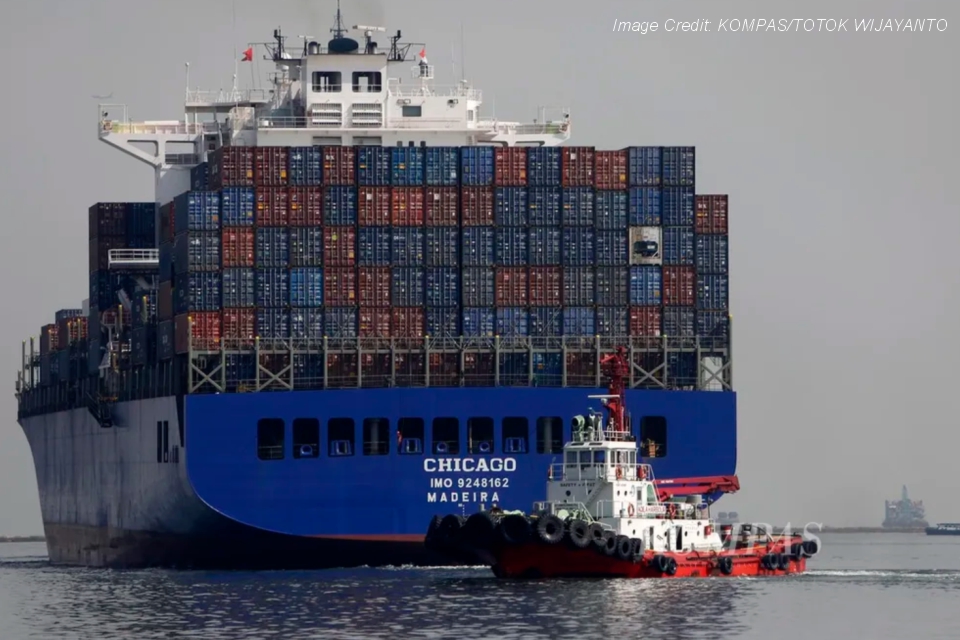
For big container shipping lines, the Asia-US route decides how well the whole company does. If this route makes money, the company usually does well. If it loses money, profits from other routes may not be enough to cover it.
This route depends on cargo going in one direction. In 2025, about 19 million TEUs (20-foot containers) went from Asia to the US, but only about 5 million came back. The trip to the US pays for the voyage. The trip back often carries empty containers, or low-value, heavy cargo that only covers part of the cost.
Indonesia’s promised purchases from the US, such as LPG, crude oil, gasoline, soybeans and wheat, come on tankers and bulk ships, not in containers. So they do not fill the containers on the way back.
When tariffs hurt Asian exports to the US, the shipping lines lose their main income. We have seen signs of this. OOCL’s profit fell 41.2% in 2025, and ONE’s profit fell 86% in one quarter last year. Both were linked to tariff problems on the Pacific route.
Indonesia is much smaller than China or Vietnam on this route. But the proposal covers 14 economies at the same time. If cargo on the route falls overall, shipping lines will cut ships or schedules. Small Indonesia-US services could be reduced, or prices could go up.
What should be done?
The government says it will work with ministries, businesses and industry groups to ask for exemptions during USTR’s comment period, which closes on Jan. 5. The first priority is making sure products that had zero tariff before are on the new exemption list.
The request will be stronger with real data, including logistics data: how much cargo, how many containers and how many jobs depend on the US route. Port and shipping companies should speak up through their associations.
Industry Minister Muhammad Sarmuji says the government is also looking for new markets, such as the newly signed trade agreement with the European Union. For ports, new markets mean new routes and different needs for ship space.
The tariff is not final. But those who only prepare after it starts will be too late. At the port, time is money.