





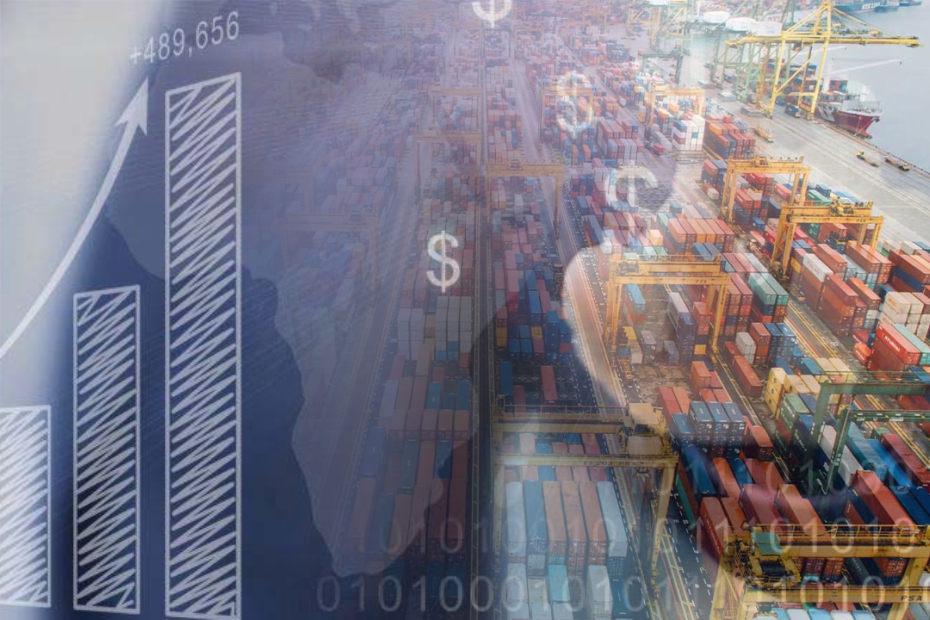
Approaching the end of first quarter this year (Q1/2021), the national economy performance started to show improvement, proved by increasing trade volume, industry production, and increasing investment.
Indonesia’s trade activity has demonstrated a good growth, proved by the export/import
volume and values in the first quarter (Q1/2021). Data from Central Bureau of Statistics BPS says the Q1/2021 export value reaches US$48.90 billion, increasing 17.11% year on year.
During the period, the export in March led the growth. The March export value reached US$18.35 billion, increasing 20.31% month to month (compared to February 2021) and up 30.47% year on year (compared to March 2020). Just like export, the import in March also grew up the highest. The March import value reaches US$16.79 billion, up 26.55% month to month and 25.73% year on
year.
Such export high growth was dominantly contributed by non-oil and gas sector. The Ministry of Industry explained that Indonesia’s trade balances of non-oil and gas enjoyed surplus by $3.69 billion in the first quarter (Q1/2021), thanks to the increasing export of manufacturing products. The cumulative value of manufacturing export during the period reached $38.96 billion, increased 18.06% year on year.

Minister of Industry Agus Gumiwang Kartasasmita explained that the manufacturing products continued its contribution domination to Indonesia’s export value amid the pandemic Covid-19 outbreak. “During Q1 this year, the manufacturing sector contributed more than 79.66% of the total national export value, which was accounted to $48.90 billion,” he said.
Gumiwang named three leading commodities: food and beverage ($9.69 bln); steel products ($5.87bln); and chemical and related-chemical products ($4.18 bln). Bambang Sabekti, a professional in maritime industry, affirmed it, saying in addition to this data, the recovery of economy and trade in Q1 were also reflected in the export/import volume and the port’s productivity.
Refinement in a number of economic indicators in the first quarter of this year were
seen in the performance of trade that shows the imports of raw/supporting material and
capital goods that the produced goods will be re-exported. Indonesian manufacturers
are on an expansion path throughout the first quarter this year. The export performance also shows significant increase, so in March 2021 reached a surplus in national trade balance.
The export and import activities via Tanjung Priok port in March 2021 also experienced increase. In March 2021, the international volume (throughput) in Tanjung Priok grew double digit, by 18% month to month, while the accumulative for Q1 (January-March) 2021 grew 0.99% year on year. It is not bad amid the pandemic was still going on. The International volume at Tanjung Priok represented 67 percent of the total throughput in Tanjung Priok; and the rest is domestic. According to Bambang, the economic recovery of the United States (USA) and Tiongkok also gives contribution towards Indonesia’s Balance of Trade (IBOT) in March 2021. The two countries are Indonesia’s trade partners. The Central Bureau of Statistic BPS recorded the balance of trade experienced surplus for US$ 1.57 Billion.

Quoting the Indonesian University Chancellors as well as an economy expert Ari Kuncoro, Bambang said, “The surplus in March is a productive surplus as both export and import experienced positive growth.”
In the previous years, the surplus happened when the imports plunged deeper than exports. “Today becomes healthier as we see this is the effect from the United States of America’s and Tiongkok’s economy that starts to grow up,” said Bambang.
BPS’ record showed Indonesia’s exports to Tiongkok experienced an increase for US$ 774.6 million and to the United States of America increased for US$ 212.6 million. In addition to the increasing trade volume and value, Bambang also highlighted the investment
rate as another indicator of the economy growth.
“Business players (entrepreneurs) are getting excited to move the economy. Many entrepreneurs look for new fund resources to make business expansions and development as they see the economic condition is getting recovered, plus the vaccines have been/are distributed evenly to fight against the Covid-19,” Bambang said.
Good Signs for the Whole Year
The success of Covid-19 vaccination program in Indonesia and in other parts of the world, also in Indonesia’s primary trading partner countries like China, India, and the United States of America make the volume (throughput) in Tanjung Priok will continually increase in the next months ahead, according to Bambang.
Moreover, the scarcity of containers has subsided as what the writer sees, almost every week the Main Lain Operator (MLO) sends an empty container to Jakarta to accommodate the needs of export. Also, for MLOs, Jakarta’s markets should be maintained for Jakarta, which becomes the center of economy in Indonesia, is the valuable market for them.
In 2021, IPC targeted container flows for 7.2 million TEUs or increased by 7.2 percent compared to the realization of 2020. Such a reasonable target considering the industries and manufactures that are becoming more active and stronger with the PMI (Purchasing Manufacturing Index) over 50 that is 53.2 or entering an expansive zone. Disruption in the Suez Canal for Indonesia is not really significant for the Tanjung Priok throughput.

Chairman of Supply Chain Indonesia (SCI) Setijadi echoes the views. He says, the performance of export import in March and in Q1/2021 indicated that the economy recovery continued to be better.
Setijadi said the increasing of export import had significantly triggered a positive growth in logistics activities. The shipping sector, both interisland and oceangoing grew up satisfyingly, so do in logistics activities of inland transport and warehousing. The logistics business had been benefited from the increasing import in March which was dominated by the raw material for
manufacturing.
The logistics business was also benefitted by the increasing of export of manufacturing products, said Setijadi. “In addition, the high domestic distribution of manufacturing products has significantly triggered the logistics business during the period,” he said.
Setijadi gave some examples in logistics sub-sector of warehousing. This sub-sector, he said, has being continued to grow even since the last quarter of 2020 (Q4/2020). In Q4/2020, the warehousing grew up 5.64% from the earlier period (q-to-q). “The growth continued in Q1 and Q2 of 2021,” he said.
This article was published in ISG Print Magazine May 2021 Edition.