





By Bambang Sabekti, Port, Logistics, and Maritime Transport Practitioner
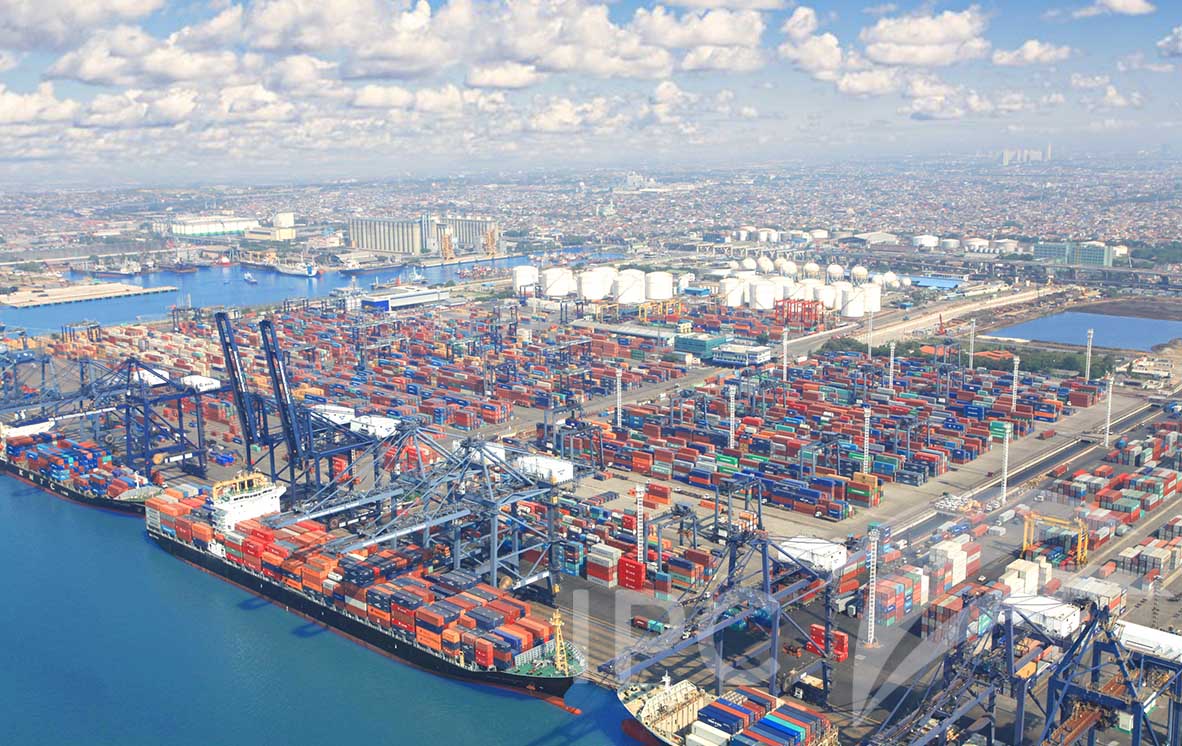
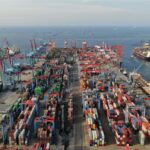
Congestion along the Cakung-Cilincing corridor, Jalan Cacing, and Marunda has once again drawn public attention. Capt. Subandi, Chairman of the Indonesian National Importers Association (GINSI), has complained about long queues of trucks triggered by empty container depot activity around Tanjung Priok. Jakarta Governor Pramono Anung explained the underlying cause: an imbalance in container flows, with import volumes rising sharply while empty containers needed for exports declined drastically, leaving thousands of empty containers stranded at depots. As a quick response, Pramono banned empty container trucks from parking on public roads and redirected them to Tanah Merdeka Terminal as a free buffer zone, while Jakarta Transportation Agency Head Budi Awaludin has expressed hope that Pelindo’s depot capacity could be raised from 65 percent to 75-80 percent.
This pattern is hardly new. Since a container fire at NPCT-1 disrupted the gate system in May 2024, the Tanjung Priok area has rarely been truly free of major congestion. Power and IT system disruptions at the terminal followed in September 2024. A surge in loading and unloading activity together with truck pile-ups in April 2025 even prompted a formal evaluation by Pelindo and the Ministry of Transportation into terminal capacity violations.
Entering 2026, the same pattern kept repeating: truck pile-ups at the Semper Toll Exit and flooding around the port area in January, disruptions at the port’s entrance gate on Jalan Yos Sudarso later that same month, severe congestion in March that led truck drivers to switch off their engines while waiting, and gridlock that briefly paralyzed the port area in May. This string of incidents shows that congestion at Priok is not an isolated event, but a recurring symptom of operational pressure on the port, terminal capacity, and land-side logistics connectivity that remain out of sync.
Amid this pressure, Pelindo just soft-launched Terminal 2 Petikemas at Tanjung Priok on Saturday (1/8/2026), marked by the maiden berthing trial of the container ship MV Meratus Konawe. The new terminal has a 517.5-meter berth — with 200 meters ready for initial operation — a stacking capacity of 8,425 TEU, supported by one Quay Container Crane (QCC), four Rubber Tyred Gantry Cranes (RTGC), and the ability to serve vessels of up to 30,000 DWT. Pelindo President Director Achmad Muchtasyar placed the terminal within the company’s Pelindo Indonesia Network Pendulum (PINP) concept, which targets up to 20 new shipping corridors, with seven corridors expected active by the fourth quarter of 2026. Tanjung Priok Port Authority Head Capt. Heru Susanto welcomed the move, while reminding that operations must still comply with Minister of Transportation Regulation No. PM 50 of 2021.
This is precisely where the issue that deserves scrutiny lies, rather than simple celebration. Terminal 2 adds berth and handling capacity inside the port, but road network capacity leading to the port has not grown in step. The main access road long projected to relieve pressure on the Cakung-Cilincing and Marunda corridor is the New Priok Eastern Access (NPEA), an elevated road roughly 6.6 kilometers long that will connect Kalibaru Terminal directly to the Cibitung-Cilincing Toll Road (JTCC). Yet the construction contracts for NPEA Section 1 and Section 2 were only handed over in July 2026, with Section 2 targeted for roughly 20 months of construction. This means NPEA will most likely not be operational by the time Terminal 2 begins absorbing more vessels and cargo.
In other words, adding berth capacity without a matching increase in road capacity risks pushing more truck traffic onto the access route that exists today: the New Priok South Access (NPSA), better known among operators as the Southern Access Road (SAR) — currently the only corridor leading to NPCT-1, which according to NPEA’s own project documents has already reached maximum capacity. This pattern mirrors the structural problem GINSI has long complained about and that the Indonesian Logistics and Forwarders Association (ALFI) Jakarta has flagged regarding the relaxation of the Yard Occupancy Ratio (YOR) from 65 percent to 70 percent: adding capacity at one point without aligning capacity at another simply shifts pressure rather than removing it. From 6 July to 6 August 2026, the Indonesian Trucking Association (Aptrindo) Jakarta has even imposed a depot congestion surcharge (DCS) of Rp600,000 per 20-foot container and Rp800,000 per 40-foot container because of the same congestion — proof that the extra burden on Priok’s access corridor already carries a real price borne by businesses.
This is exactly where Patimban’s significance as a more genuine solution lies, rather than merely a complementary one. Unlike Terminal 2, which adds throughput onto an already-saturated road corridor, Patimban sits entirely outside Priok’s troubled road network. Roughly 80 percent of the country’s manufacturing industrial estates are located in West Java, Patimban’s natural hinterland, meaning cargo diverted there genuinely reduces the number of trucks that must pass through Cakung-Cilincing and Marunda, rather than adding to that volume. Momentum at Patimban keeps building: PT Jasa Armada Indonesia Tbk (IPCM) successfully piloted the Panamax vessel MSC Bremerhaven V on 3 August 2026, with projections for weekly calls by Handymax/Supramax to Panamax-class vessels reaching 3-4 visits a month. Patimban Class II Port Authority Head Mohd. Arief Agustian had already signaled in early July that more global shipping lines would enter Patimban by August 2026 — a signal now materializing through news that Samudera Indonesia will carry export cargo for Ocean Network Express (ONE), a global carrier with no ownership stake whatsoever in the PT Patimban Global Gateway Terminal (PGT) consortium.
That said, Patimban is not yet free of similar homework. Loading and unloading there still relies on Mobile Harbour Cranes (MHC), while the access toll road to the port — according to Tanjung Priok Port Authority Head Capt. Heru Susanto — is not targeted to be operational until the third quarter of 2027. Until that toll road is complete, Patimban’s volume growth will temporarily depend on the national road network and the Trans-Java Toll Road, rather than the direct access designed for it.
Data from the Coordinating Ministry for Economic Affairs show Indonesia’s logistics costs still stand at around 14.29 percent of Gross Domestic Product (GDP), against a gradual target of 12.5 percent under the 2025-2029 National Medium-Term Development Plan (RPJMN). The National Logistics Ecosystem (NLE) framework was designed to simplify service processes, but the experience of Terminal 2 and NPEA shows that digitalization means little if physical capacity added at one point is not matched by supporting infrastructure capacity at another.
Three things therefore need to be secured so that Terminal 2 genuinely eases, rather than adds to, the pressure at Priok. First, accelerating NPEA’s completion needs to become a priority aligned with Terminal 2’s capacity ramp-up, rather than a project running on its own separate track. Second, the government needs to ensure that the arrangement of empty container depots along the access corridor does not lag behind the addition of berth capacity. Third, a permanent coordination forum involving the Port Authority, Pelindo, terminal operators, the Jakarta provincial government, and user associations such as GINSI, Aptrindo, the Indonesian Exporters Association (GPEI), and ALFI needs to ensure that every addition of port capacity is discussed together with the readiness of its supporting road network, rather than decided sector by sector as has been the case so far.
Tanjung Priok and Patimban are not two competing ports, but two nodes within a single national logistics system. Yet both demand the same honesty: adding port capacity without aligning road capacity only shifts congestion rather than eliminating it. As long as NPEA remains unfinished, Patimban — with all its own limitations still being worked out — is, for now, the more genuine solution for Priok, because it truly diverts the burden away from an already-saturated corridor rather than adding to it.
*******
About the writer: Bambang Sabekti is a port, logistics, and maritime transport practitioner. He is an alumnus of the Business Administration program at Universitas Indonesia and holds a Master of Management degree from Universitas Airlangga, with more than 36 years of experience in shipping, logistics, and port industries. His career includes serving as director of Indonesia American President Lines (APL) and APL Logistics, and senior advisor to the board of directors of New Priok Container Terminal One (NPCT1). He currently serves as director of PT Bintang Laut Platinum, a multimodal transport company serving exports and imports. He serves on the Journalistic Works Jury Board 2026 in celebration of PT Jasa Armada Indonesia Tbk’s anniversary, and the Journalist Writing Jury Board 2023 in celebration of PT Pelindo (Persero)’s anniversary. His writing is published regularly in Katadata, Kompas.com, RMOL, Inilah.com, and Indonesia Shipping Gazette.