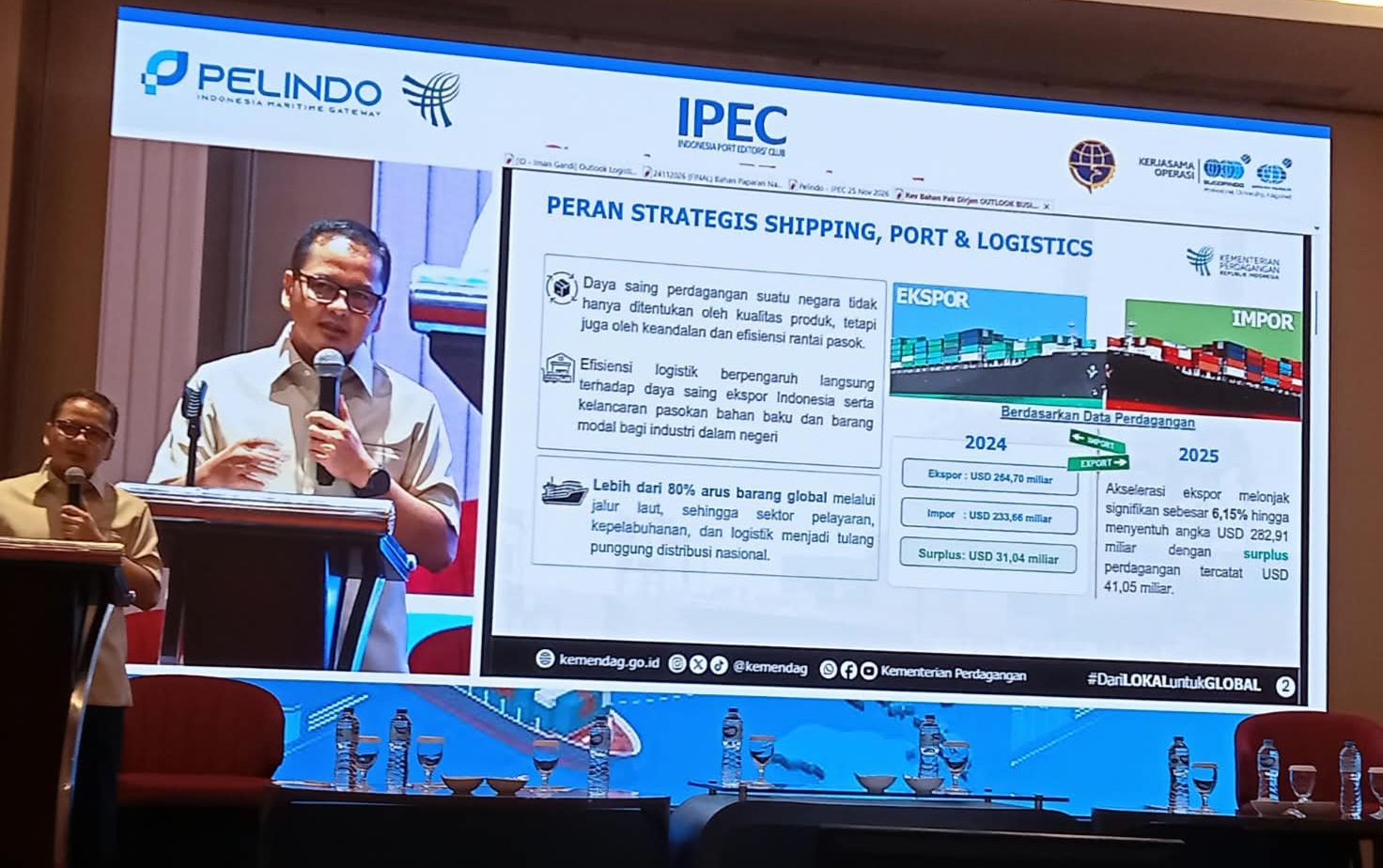
While demand collapse continued in October 2022, the total throughput of Tanjung Priok (International and Domestic) until October 2022 increased by 3.56% YoY compared to YTD 2021. The domestic throughput YTD slightly increased by 0.59%, and the International YTD throughput increased by 5.01%. It was a fantastic number when global demand was declining.
Statistics Indonesia (BPS) data show that China remains Indonesia’s largest partner for exports and imports this year. The lower mobility restrictions would result in higher-than-expected Chinese economic growth. Chinese demand for Indonesian export commodities like coal, processed nickel, iron, and crude palm oil (CPO) would also increase more than previously expected. The relaxed rules were also expected to prompt more Chinese investment into Indonesia’s processing industries for minerals such as nickel, bauxite, and cobalt.
Now that mobility restrictions have been eased, this may facilitate some Chinese businesses to relocate to Indonesia. Moreover, higher spending among Chinese consumers would lead to demand growth for Indonesian products. There will be a diversification of export products to higher-value and technology-intensive goods. China’s exports and imports shrank at a much steeper-than-expected pace in November, as weak global and domestic demand, COVID-induced production disruptions, and a property slump at home piled pressure on the world’s second-biggest economy.
Global demand in October 2022 dropped since the initial decline observed in September 2022. Using “TEU*Miles” as an indicator of demand, October 2022 levels were observed to be 12.8% lower than in 2021 and 7.7% lower than before the pandemic in 2019. Import and export volumes across all regions in October 2022 dipped below pre-pandemic levels, except for the Indian Subcontinent/Middle East and South/Central America (imports). Europe and North America imports showed the sharpest YOY decline of 19% in October 2022 compared to other regions. Compared to before the pandemic, Europe imports were 11% lower than in October 2019, and North America imports have returned to October 2019.
Minister of Finance Sri Mulyani Indrawati has reminded us that Indonesia’s export performance in 2023 would decline due to global uncertainties, and Indonesia’s export would not grow like in 2021/2022. Indonesia’s leading trading partner is experiencing a slowdown because of the economic recession. The United States (USA), Europe, and China are three.
Global Market Update
Regional price normalization. Take a closer look at the development in rate levels on a region-to-region basis across the globe to ascertain the current status of the renormalization of rate levels versus 2019. Based on the study shows that trades that are prone to significant rate increases are also trades that are prone to sharp declines. Conversely, trades not exposed to massive rate increases also normalized at a slower pace.
One of the top 5 carriers has told investors that group EBITDA will likely come in between USD 4.0-5.0 bn in the year’s final three months, a range representing a drop of between 45-56% on the previous quarter’s USD 9.1 bn. Freight rates have fallen much quicker than anticipated by carriers after a perfect storm of high inflation, overbuilt US inventory, COVID restrictions in China, a shift back to service spending, and increased supply from lower congestion.
As quoted by Alphaliner, Fitch downgrades the marine sector on container outlook. Fitch Ratings said conditions in the container industry were dragging down the general outlook for maritime, causing it to downgrade its shipping sector outlook from ‘neutral’ to ‘deteriorating’.
The rating agency’s decision is linked primarily to the ‘significantly weaker’ profits expected in the container segment following the near normalization in freight rates.
Fitch said the main risks now were a harsher recession than expected and the continuation of pandemic-related lockdowns in China that could lead to further weakness in demand and manufacturing. Though not likely, it said that any port capacity limitations in China in excess of lockdown-related production limitations could be positive for container freight rates. Fitch noted prospects in the tanker and dry bulk sectors were “more stable” due to their small order books, at 4% and 7% of the fleet, respectively. The container ship order book is today equivalent to 29% of the fleet.