
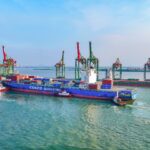
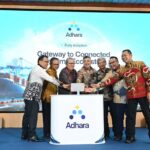

President Joko Widodo (Jokowi) inaugurated Kijing Terminal on Tuesday, August 9, 2022. The terminal location is in Mempawah Regency, West Kalimantan Province is later targeted to replace Pontianak Port gradually. The utilization of Dwikora Port, located in an urban area, is optimal. With limited land, it is also challenging to expand Dwikora Port.
Present at the inauguration ceremony were Minister of State-Owned Enterprises Erick Thohir, Minister of Transportation Budi Karya Sumadi, as well as Minister of Public Works and Public Housing Basuki Hadimuljono, Governor of West Kalimantan Province Sutarmidji, Regent of Mempawah Erlina Ria Norsan, Board of Commissioners and Directors of PT Pelabuhan Indonesia ( Persero)/Pelindo, as well as traditional, religious and community leaders of Mempawah Regency.
Kijing Terminal is a National Strategic Project built based on Presidential Decree no. 43/2017 concerning Acceleration of Development and Operation of Kijing Terminal at Pontianak Port in West Kalimantan.
“The construction of the Kijing Terminal is in line with one of the targets for the merger of Pelindo, whose role is to support more coordinated infrastructure development to create maritime connectivity and industrial downstream,” said Arif Suhartono, President Director of Pelindo, Tuesday (9/8/2022).
The construction of the Kijing Terminal is divided into three stages, Phase 1 Initial, Phase 1 Advanced, and Phase 2. The construction of this Initial Phase includes a pier with dimensions of 1,000 meters by 100 meters wide, a Port Management Area (200X100 m), a road leading to the dock (trestle) along 3 .45 km with a width of 19.8 meters, a container terminal, and a multipurpose terminal.
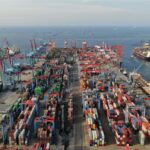
This Terminal has four areas, namely containers with an initial stage capacity of 500 thousand TEUs and a final stage capacity of 1.95 million TEUs per year, a dry bulk area with an initial stage capacity of 7 million tons and a final stage capacity of 15 million tons, a liquid bulk area with a capacity the initial stage of 5 million tons and the final stage capacity (12.18 million tons), and a multipurpose area with an initial stage capacity of 500 thousand tons and a final stage capacity of 1 million tons. This port area reaches 200 hectares, including the Terminal and backup port areas.
“In the future, this Terminal will gradually replace the role of the existing port in Pontianak. The Pontianak port will later be maximized to serve other activities such as passenger ships or Ro-Ro ships and other services to support inter-island passenger activities using sea transportation,” said Arif.
West Kalimantan is in dire need of a new port. Last year, the utilization of Dwikora Port had reached 257 thousand TEUs, or 86 percent of the port’s capacity. Land for expansion is also no longer available. The sedimentation rate upstream of the Kapuas River and the channel’s narrowing impact the high cost of dredging operations. The channel width has narrowed from 60 to 40 meters in the last five years.
“The Kijing Terminal of Pontianak Port, whose construction began in 2016, has been completed today. The existence of this port will strengthen the competitiveness of superior products produced by the province of West Kalimantan because here it has excellent strengths such as crude palm oil, alumina, and bauxite, “said President Jokowi in his remarks.
CPO production in 2021 will reach 5 million tons and is estimated to be at 7 million tons in 2030. West Kalimantan also has the largest bauxite reserves in Indonesia, namely 840 million tons or 67 percent of the total bauxite reserves in Indonesia. In addition, the potential for developing an industrial area that is integrated with Kijing Terminal is still wide open. So it takes about 2,000-3,000 hectares of land that can be used for industrial sites and industrial downstream programs.
Jokowi also added that to realize the goal of increasing competitiveness, the road needs to be widened. So that container and non-container travel can run smoothly. “So do not let this large investment cannot strengthen competitiveness and cannot improve connectivity between ports, islands and between countries,” said Jokowi.
“Kijing Terminal is projected to be the largest international port area in Kalimantan and will become one of the hub ports in Indonesia, where at the beginning of its operation it was used for multipurpose services,” continued Arif.
On the same occasion, Minister of Transportation Budi Karya Sumadi added that for the operation of the Kijing Terminal to be optimal, synergy between Ministries and Institutions is also needed.
“I hope that the synergy between stakeholders such as relevant central and regional government agencies, business actors, and other stakeholders will continue to optimize the utilization of Kijing Terminal. So that the noble goal of developing this Terminal can be realized, namely encouraging Indonesia’s economic growth, especially West Kalimantan,” said Minister of Transportation Budi.
After the inauguration activity, Arif explained his hope for the government to stimulate more activities for this new Terminal. “First, we ask the government to facilitate the widening of arterial roads so they can accommodate heavy vehicles. Second, there is toll road access that connects the trading cities of Singkawang and Pontianak. Finally, we hope the government can provide around 2000-3000 hectares behind the port, which is only intended for industrial activities to support port activities”.