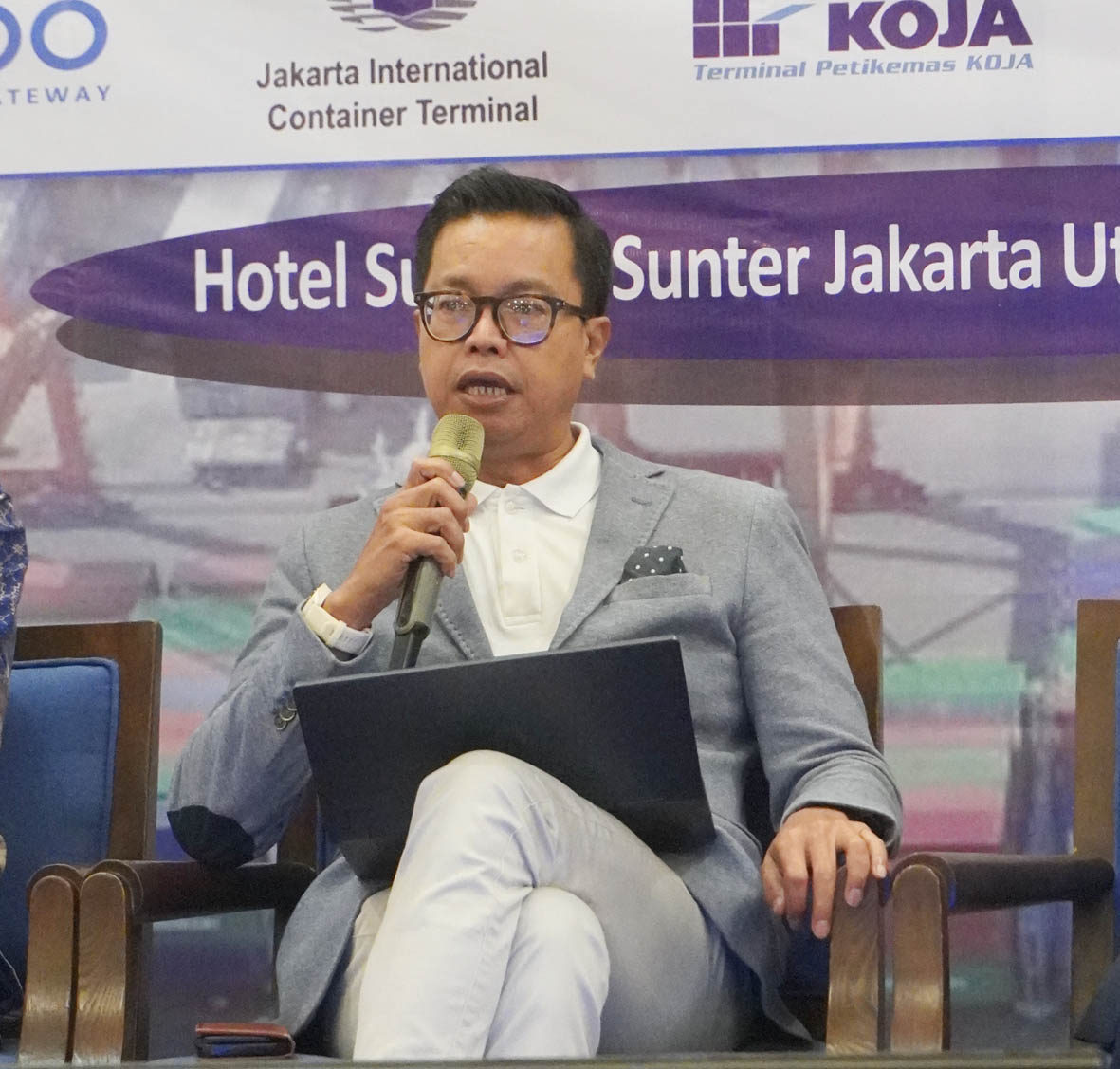







Bambang Sabekti, National Port and Logistics Practitioner
The United States has accused Indonesia of being part of a transshipment network used by China to circumvent US tariffs. The allegation, however, confuses a normal shipping practice with tariff circumvention and reaches a conclusion that cannot be established simply from Indonesia’s trade relationship with China or the movement of Chinese goods through Indonesian ports.
The allegation appeared in the White House report The Great Transshipment Scam, which placed Indonesia in Tier 2 alongside Brazil, Malaysia, Thailand, Türkiye and Vietnam. The report describes what it calls China’s “shadow transshipment network”, alleging that Chinese goods are routed through third countries before entering the US market through practices such as repackaging, relabeling, minor processing, changes to commercial documents and false claims of origin.
Indonesia has rejected the allegation. Coordinating Minister for Economic Affairs Airlangga Hartarto said Indonesia had neither been involved in nor informed about the study and described its findings as based on assumptions that did not reflect actual conditions in Indonesia.
The distinction matters. There is a fundamental difference between a Chinese container being transshipped through Indonesia and Chinese goods being deliberately routed through Indonesia to disguise their origin and avoid US tariffs. The first is a normal logistics operation. The second is a trade-compliance violation that requires specific evidence.
Indonesia therefore should not be characterized as a tariff-evasion route merely because it has strong trade and supply-chain links with China, uses Chinese raw materials or components, or has ports through which international cargo is transshipped. Those facts may demonstrate supply-chain integration, but they do not prove tariff circumvention.
Transshipment is a normal part of international shipping. Not every vessel calls at every port. Containers may be carried to a hub port, transferred from one vessel to another, and then continue to their final destination. Such arrangements are determined by shipping networks, vessel schedules, port connectivity and commercial considerations.
Consider a simple example. Cargo from Shanghai may be shipped to Jakarta on the first sector and then continue from Jakarta to Los Angeles on a second sector. The container may change vessels in Jakarta because the shipping line’s network requires it. This does not, by itself, change the origin of the cargo.
The situation would be different if goods originating in China were deliberately routed through Indonesia, underwent no qualifying transformation, and were then falsely declared as Indonesian goods when exported to the United States in order to obtain lower tariffs.
That is the allegation that must be proven—not simply the fact that the cargo passed through Indonesia.
Shipping documents also need to be understood in this context.
A Bill of Lading, or B/L, is a shipping document containing information about a shipment, including the shipper, consignee, Port of Loading (POL), Port of Discharge (POD) and cargo description. B/L information also forms part of the cargo information contained in the manifest.
The same cargo can have different shipping patterns and commercial relationships reflected in its shipping documents. A shipment may involve a Shanghai-Jakarta sector followed by a Jakarta-Long Beach sector, with different shipper and consignee relationships in each sector. In another arrangement, cargo may move from Jakarta through Singapore to Los Angeles.
Such arrangements are not unusual in international trade.
A change in the shipping sector does not automatically change the origin of the goods. Nor does a change in shipper or consignee, by itself, prove that the origin of the goods has been falsely changed.
To establish tariff circumvention, there must be evidence connecting the Chinese-origin goods, the activity carried out in Indonesia, the commercial transaction, the relevant shipping and trade documents, and the declaration made when the goods enter the US market.
This is particularly important when assessing industries cited in support of the US allegation.
The Indonesian government has explained that industrial areas such as Batam and Bekasi have existed and developed since the 1990s. Their connection with international supply chains does not automatically mean that they are being used to disguise Chinese goods before export to the United States.
The same applies to plastic products and packaging. Indonesian manufacturers may use imported materials or components, including from China. But the presence of Chinese inputs does not automatically make the finished product a Chinese product, nor does it prove that the product has merely been relabeled in Indonesia.
What matters is what actually happens to the goods in Indonesia and whether the resulting product meets the applicable rules of origin.
This is a fundamental principle in global manufacturing. Modern supply chains rarely operate within a single country. Raw materials, components, processing and final assembly may take place in different countries. Therefore, identifying a country as part of an illegal transshipment network requires more than showing that it has strong trade and production links with China.
Indonesia certainly needs to take the US concern seriously. Customs authorities and other relevant agencies should ensure that goods exported to the United States comply with applicable rules and that no company uses Indonesian territory to circumvent tariffs.
But stronger enforcement should not lead to a broader and inaccurate conclusion that normal transshipment through Indonesia constitutes tariff circumvention.
Indonesia is deeply connected to China’s supply chain. Indonesian ports are also connected to global shipping networks. Both are facts. But neither fact proves that Indonesia is being used as a route for Chinese goods to enter the United States illegally.
The allegation therefore needs to be tested against actual evidence: Which goods? Which transactions? What processing took place in Indonesia? Which documents were used? And which rule was allegedly violated?
Without clear answers to those questions, identifying Indonesia as a Chinese transshipment route for tariff circumvention goes beyond what the available facts can establish.
Transshipment is not tariff circumvention. Chinese goods moving through Indonesia do not automatically become Indonesian goods. And Indonesia’s trade relationship with China is not evidence that Indonesia is helping China evade US tariffs.
The issue should ultimately be decided by facts, documents and applicable trade rules—not assumptions based simply on Indonesia’s position in the global supply chain.