






By Dhany Novianto, Logistics Practitioner
Indonesia’s logistics costs are frequently cited at around 23% of gross domestic product, a figure that has become a familiar reference point in debates over the country’s competitiveness.
But the number needs qualification!
Under a newer government methodology, national logistics costs were estimated at about 14.29% of GDP in 2022. The widely cited 23.08% figure uses a broader calculation, combining domestic logistics costs of about 14.1% with export logistics costs of 8.98%. Because the methodologies differ, the figures should not be treated as directly comparable measures of change over time.
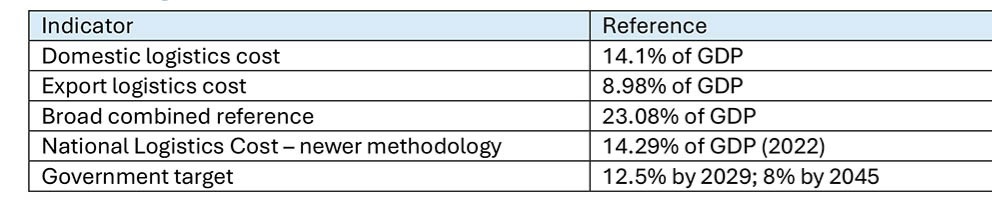
Table 1: The Big Picture of Logistics Cost to GDP
For businesses, however, the more important question is not simply how large the cost is. It is where money and productivity are being lost across the supply chain.
Where Is the Money Actually Going?
One analytical breakdown attributes approximately 7% of GDP to land transportation, 3.6% to maritime transportation, 1.5% to warehousing, 0.8% to air transportation and 1.2% to administration.
These figures are best viewed as directional rather than as a single reconciled national-accounts table. Even so, they highlight the importance of land transportation and, more significantly, the interfaces between different parts of the logistics system.
The problem is not necessarily that trucking rates are too high. Often, the underlying issue is poor asset utilisation.
A truck continues to incur costs while stationary. Driver wages, depreciation, financing, maintenance, tyres, insurance and other expenses do not disappear when a vehicle waits at a factory, depot or port.
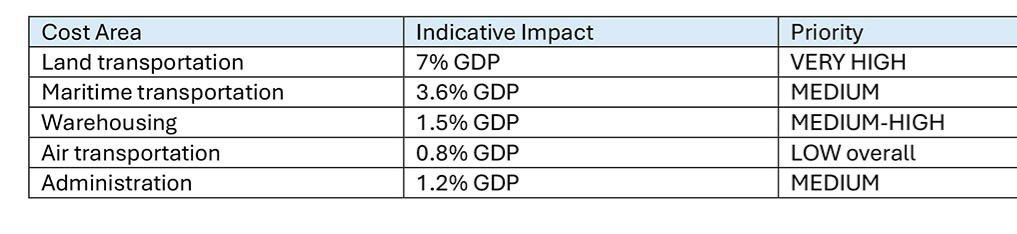
Table 2: Contribution of Each Subsector to GDP
If a truck capable of making two productive trips a day completes only 1.2 because of queues and loading delays, its costs do not fall proportionately. The same costs must be recovered from fewer productive movements, raising the cost per trip.
Waiting time is therefore a logistics cost, even when it does not appear on an invoice.
Time Is Capacity
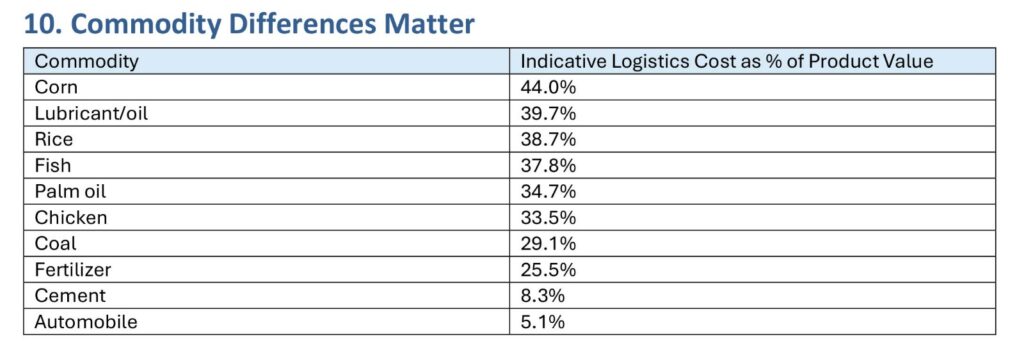
A truck queue outside a factory may not be recorded as a separate charge, but the economic loss is real. The same applies to containers waiting between transport modes, warehouses operating below potential because inbound shipments are unpredictable, and terminal resources affected by irregular cargo flows.
In logistics, time is capacity.
Every hour an asset remains idle is an hour of productive capacity that cannot be recovered and sold later.
This matters particularly for Indonesia, where geography creates long transport distances and complex maritime connections. Some costs are unavoidable. Delays caused by operational friction are not.
A single cargo movement can involve a shipper, trucking company, depot, freight forwarder, shipping line, terminal, customs authorities, warehouse, distributor and final customer. Each organisation may perform its own task efficiently while the overall shipment remains inefficient.
A truck may arrive before a container is ready. A container may reach a terminal before the receiving warehouse has a slot. A vessel may arrive on schedule while inland transportation is unavailable.
Documentation may also be accurate within individual systems while information remains unsynchronised between organisations.
Every handover creates opportunities for delays, repeated data entry, additional handling, equipment shortages and information mismatches.
The challenge is therefore not simply to develop multimodal transportation, but to integrate the different modes and participants into a coordinated system.
Ports Need Inland Connections
Indonesia’s maritime network is fundamental to domestic distribution and international trade. But improvements at ports will have limited economic impact if inland connections remain fragmented.
A vessel can arrive on schedule and a terminal can operate efficiently, yet a container can remain stuck because a truck is unavailable, a depot is congested, a warehouse cannot receive the cargo or information has not been synchronised.
Port performance should therefore not be assessed in isolation from the road, depot, warehouse and distribution networks around it.
For shipping lines, opportunities to reduce costs may extend beyond the ocean voyage to everything that happens around a container before and after its sea journey.
The Hidden Cost of Empty Containers
Container imbalance is another structural problem.
Trade flows are rarely perfectly balanced. Import-heavy locations can accumulate empty containers while export demand exists elsewhere. Repositioning those containers consumes trucking capacity, depot space, handling resources and fuel without creating the same value as a loaded movement.
Reducing empty movements requires more than individual companies optimising their own fleets or equipment. Shipping lines, depots, trucking companies and cargo owners need greater visibility of equipment availability and future demand.
Without coordination, one company’s optimisation can simply shift inefficiency to another part of the system.
Inventory Is a Logistics Cost, Too
Transportation is only one part of the economic cost of moving goods.
When delivery times are unpredictable, companies often compensate by holding additional inventory. That ties up working capital and consumes warehouse capacity. Depending on the product, it can also generate financing, insurance, deterioration and obsolescence costs.
A shipment arriving two days late can therefore cost much more than the additional transportation expense associated with the delay.
Businesses should evaluate freight, inventory, warehousing, waiting time, handling, demurrage, detention and working-capital costs together.
The lowest freight rate does not necessarily produce the lowest supply-chain cost.
Predictability Matters, Five Priorities
The World Bank’s Logistics Performance Index measures customs, infrastructure, international shipments, logistics competence, tracking and tracing, and timeliness. The broader lesson is that logistics performance depends not only on physical infrastructure but also on reliability and predictability.
For manufacturers and retailers, a supply chain that consistently takes three days can be easier to manage than one that takes one day under ideal conditions but five days during disruptions.
Predictability affects inventory, production scheduling, truck planning, warehouse operations and customer commitments.
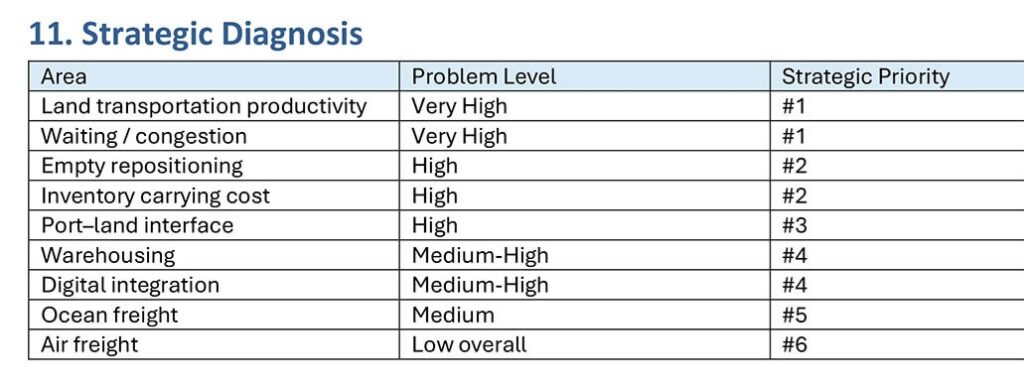
Indonesia should therefore measure logistics performance not only through kilometres, tonnes and freight rates, but also through waiting times and their variability.
Five measures could help address these productivity losses.
First, increase truck utilisation by reducing waiting time, improving load factors and increasing productive trips. This can lower unit costs without necessarily adding vehicles.
Second, integrate ports with inland transport. Vessel arrival information, terminal availability, truck appointments, depot capacity and warehouse receiving schedules should be coordinated wherever possible.
Third, improve empty-container management through greater visibility, pooling and coordinated repositioning among shipping lines, depots and inland users.
Fourth, measure total supply-chain costs rather than focusing only on freight rates. Transportation decisions should be assessed alongside inventory, waiting, warehousing and working-capital consequences.
Fifth, Indonesia could move toward a national logistics control-tower approach. Digital systems should provide more than electronic documentation; they should offer operational visibility, showing where shipments are, where delays occur, who is responsible for the next milestone and which exceptions require intervention.
The objective should not be another dashboard. It should be better coordination and accountability across the supply chain.
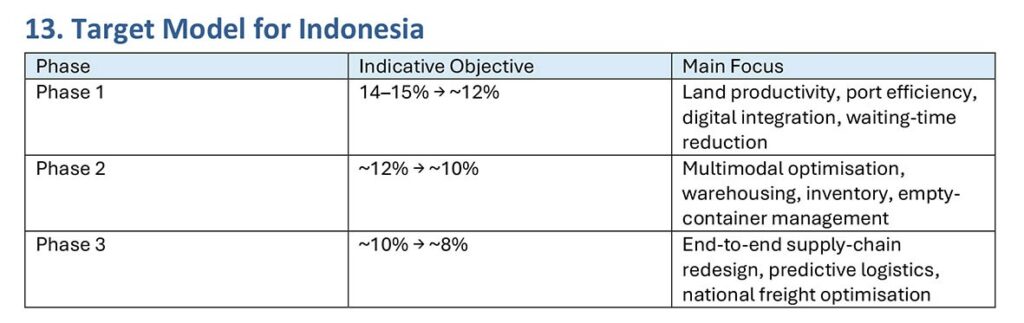
This is broadly consistent with the government’s ambition under its newer logistics-cost framework to reduce national logistics costs to 12.5% of GDP by 2029 and 8% by 2045.
From Infrastructure to Productivity
Indonesia has invested heavily in roads, ports, industrial areas and other logistics infrastructure, and further investment will remain necessary as the economy grows.
But infrastructure alone cannot eliminate productivity losses caused by fragmented operations.
The next stage of improvement may depend increasingly on making existing assets work harder.
A truck completing more productive trips can create greater value than simply adding another vehicle. A container spending less time waiting can be more valuable than additional capacity that remains underutilised. A warehouse receiving predictable inbound flows can operate with less safety stock. A port seamlessly connected to inland transportation can create more value than a port considered in isolation.
The strategic challenge is therefore shifting from simply adding capacity to coordinating capacity more effectively.
The debate over Indonesia’s logistics costs often begins with a percentage of GDP. A more useful starting point may be the hours behind that percentage: how long trucks wait, how often they return empty, how long containers sit between modes, how much inventory companies hold because delivery times are uncertain, and how many times shipments change hands.
Those measures show where productivity is actually being lost.
Indonesia does not necessarily need to reduce every freight rate. It needs to reduce waiting, empty movements, underutilised assets, unnecessary handling, excess inventory and uncertainty.
For the shipping industry, that means looking beyond the ocean voyage to the wider container ecosystem: equipment positioning, depot operations, truck turnaround, terminal interfaces, documentation, shipment visibility and inland distribution.
If these elements operate as an integrated system rather than a collection of separate processes, Indonesia can do more than reduce logistics costs. It can unlock productivity across the wider economy and strengthen the competitiveness of Indonesian businesses in regional and global markets.