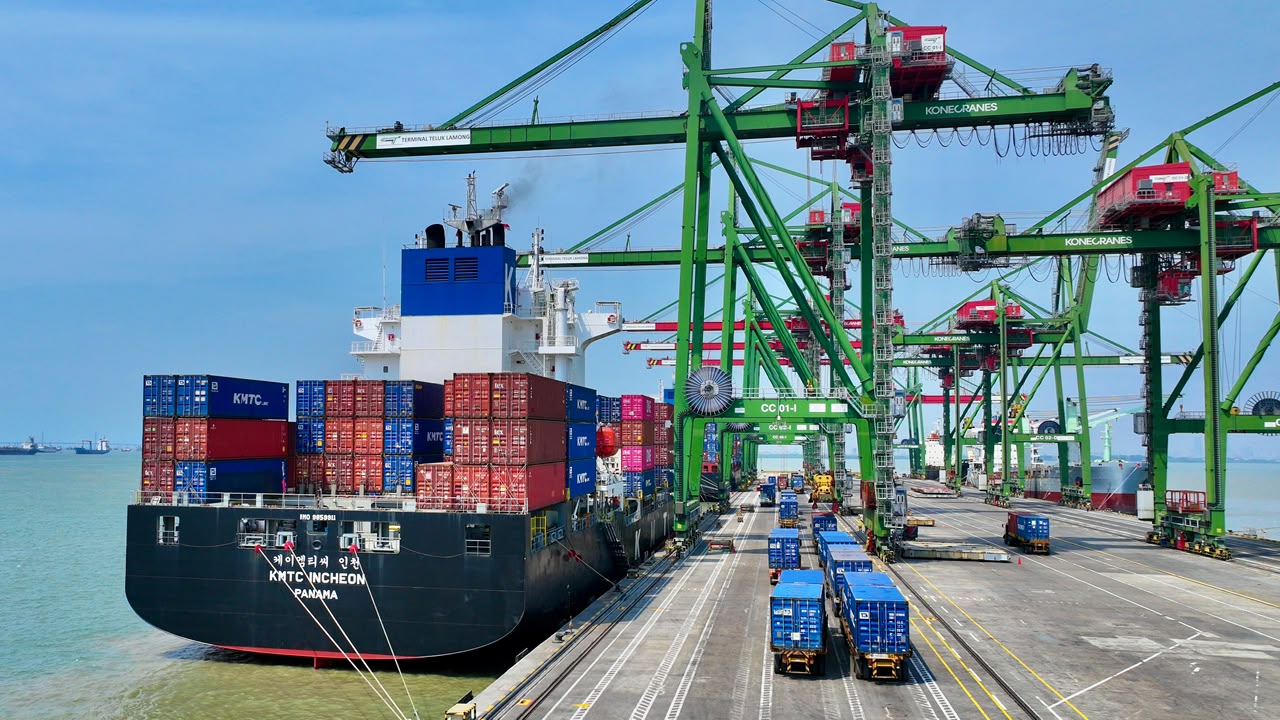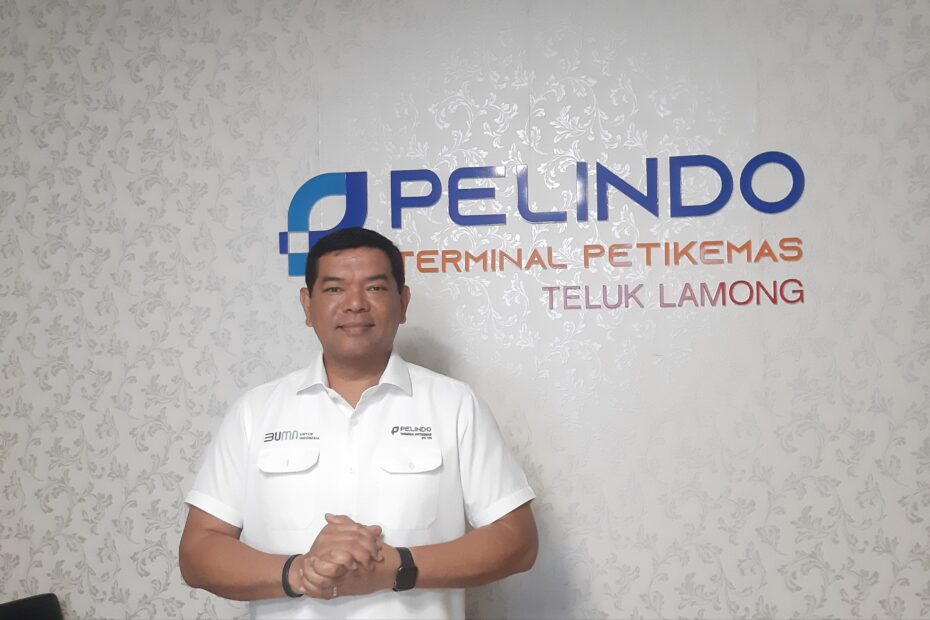
For Terminal Teluk Lamong (TTL), the second biggest terminal in Tanjung Perak in view of container throughput, longer waiting time due to big waves within the channel and basin is not a problem anymore. Since August this year (2023), there has been zero waiting time, thanks to smart ways this terminal has been taken in May.
Since its first operation in 2014, TTL has been an alternative for shipping and cargo owners in East Java, both for international and interisland (domestic). It has been a preferred choice as the terminal has been designed as a modern, smart, and eco-port, meaning that it has been supported with modern, smart, and environment-friendly facilities and systems. It runs under an automated system – an automated stacking crane (ASC). Its cranes work without site pilots. They are just remotely moved from the control tower (ASC control room).
However, though facilities have been modern, the terminal needed several years to overcome the natural problems of big waves within its channel and basin. This natural problem caused a longer waiting time as the vessel had to wait until a certain time to berth or depart. As a result, the port stay became longer.
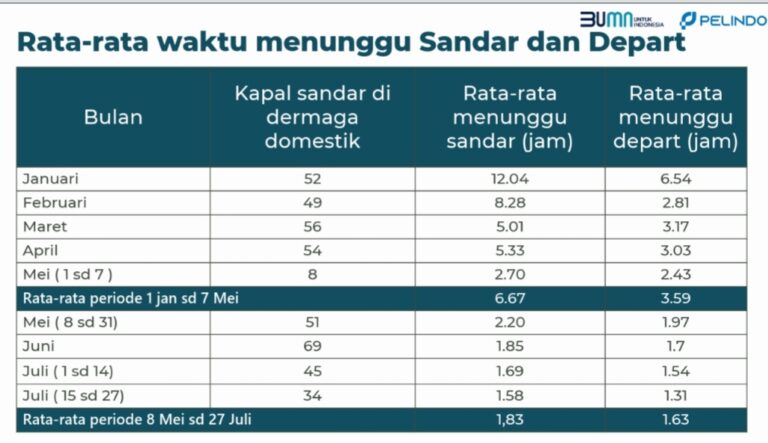
Data says that until May, the average waiting time for berthing and departure reached 6.67 and 3.59 hours per vessel, respectively. The average waiting time in January remained the longest, reaching 12.04 and 6.54 hours for each berthing and departure. The shortest took place in the last month of January-May, reaching 2.70 and 2.43 hours per vessel for berthing and departure, respectively.
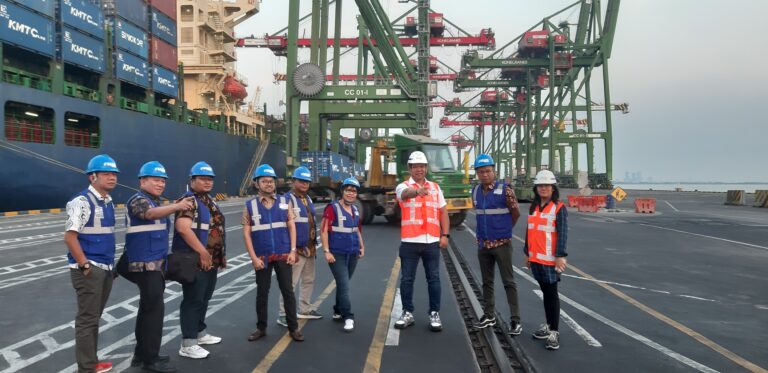
“It is true. It (longer waiting time) was our classic problem for this terminal. But it is not a problem anymore. The waiting time has been gradually shorter and shorter since May until we come to zero since August,” said David Sirait, President Director of TTL.
David, earlier extensively involved in the operation of Jakarta International Container Terminal JICT and IPC TPK, explained that there are several steps the TTL had planned to overcome the problem, including dredging the turning basin. “But, after we do an evaluation, this plan is revised. There is no need to do dredging, but just maintenance works for basin normalization at certain spots. This will save much cost,” he explained.
Sebastian Wibisono, Chairman of East Java ALFI/ILFA (Indonesia Logistics and Forwarders’ Association), admitted that waiting time has no longer become a problem for Tanjung Perak Port, including TTL.
“Pelindo, including TTL, has taken such appropriate programs and strategies to overcome the problem and to reach zero waiting time. We appreciate it very much,” Wibi told Indonesia Shipping Gazette recently.
Device AIS Plug
Referring to his extensive experience in the operational division in some of Indonesia’s leading container terminals, especially in JICT and IPC TPK, and from some of the world’s container terminals he had visited, David tried to adopt the most appropriate ways for a faster solution.
Since he chaired as president director, cutting port stay, creating zero waiting time, and zero accidents to reach optimum productivity remain David’s top target for this terminal. “First, I came here, I did intensive coordination and collaboration with marine service on collecting problems and appropriate steps for fast solutions,” he said.
“After intensive coordination and collaboration, we finally concluded. Installation of AIS plug device, operational engineering, and non-stop (24/7) services are the choices,” he explained.
The adoption of these steps contributes to the terminal performance. The waiting time for berthing and departure has gradually been shorter and shorter since May, even until zero waiting time in August. As a result, port stay became shorter.
According to the TTL operational data, the average waiting time from mid-May (May 8) until July (July 31) was down significantly compared to January – May 7. The waiting time to berth was only 1.83 hours/vessel, significantly down from 6.67 in the period of January – May 7. The waiting time for departure was also down to only 1.63 hours/vessel, down from 3.59 hours/vessel in January-May 7.
“The adoption of this device (AIS Plug) plus improvement of product knowledge and skill of marine service operators through our intensive coordination and collaboration have helped us in this position,” David explained.
David further explained that this shorter (zero) waiting time has also significantly reduced the berthing time at this terminal, from 18.96 hours on average in January – May 7 to 17.02 in May 8 – July. “This will become shorter and shorter in the next months,” said David.
The movement has also increased significantly, from 25.39 BSH (box/ship/hour) to 27.25.
Throughput Record, New Calls, Value Creation
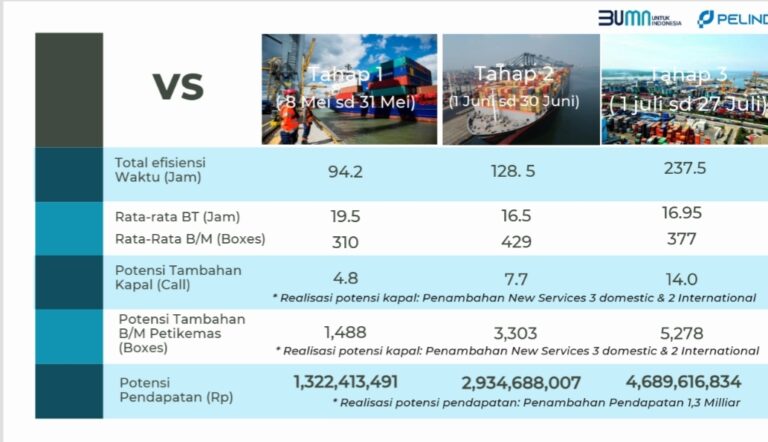
Those innovative steps that support a shorter (zero) waiting time, shorter berthing time and port stay, and modern facilities have attracted more and more ship calls. Since May, for example, there were as many as five new services (calls), including three domestics and two internationals.
“Our innovations have created so much added value, not only to us but also to shipping lines, I guess. That is why they are attracted to call here or to add more services,” said David, adding: “Some will come soon. They have expressed their initial interest.”
TTL internal analysis concludes some added values (value creation) from this innovation. The analysis says the efficiency from zero waiting time and shorter berthing time has created value creation of Rp 237.5/TEU. Assuming the TTL yearly throughput reaches 800,000 TEUs, the innovation and transformation create as much as IDR 4,689,616,834 monthly.
Another added value of this innovation comes from the cost savings from the budget for dredging. David says that adopting AIS Plug has revised the dredging plan, making cost savings by as much as IDR 74 billion.
In addition to creating such added values, the innovation increases TTL productivity significantly, even creating records. According to data, both ship calls and throughput increased significantly during months after May, even a record in throughput and ship calls in August.
Ship calls in August reached 148 units, increasing 37.04% y-o-y, compared to 108 calls in August 2022 and far above the yearly average in 2022 and 2023. This also remains a ship call record in the history of TTL. Even domestic ship calls grew by 50%, from 82 units (August 2022) to 103 units (August 2023), another record in the history of TTL.
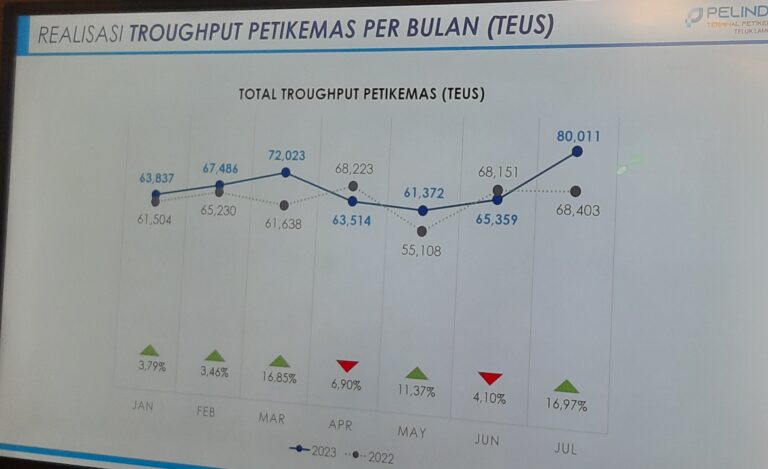
This increase in ship calls has impacted the throughput increase, both container and non-container. The container throughput increased after May, from 61,372 TEUs to 68,151 TEUs (June) and 80,011 TEUs in July. The throughput in July, which grew 16.97% y-o-y, remains a record for TTL.
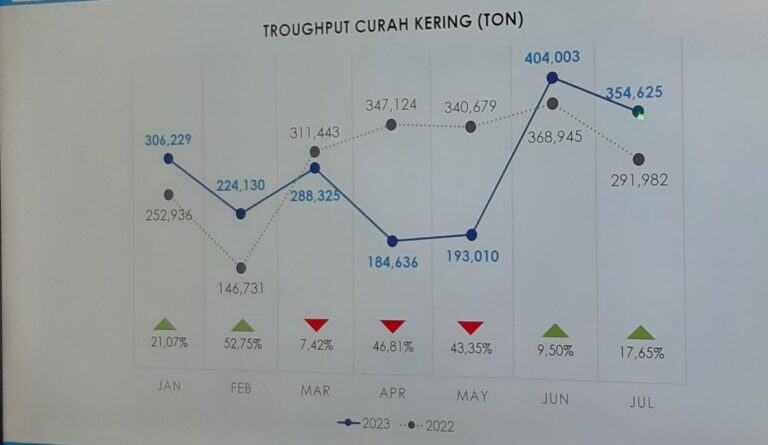
Dry bulk volume rebounded since June, after a drop in March–May. Dry bulk throughput in June reached 404.003 tons, increasing 9.50% y-o-y and a record in monthly throughput. Though it was slightly slowed down month on month, the volume in August grew by 17.65% y-o-y to 354,625 tons from 291,982 tons in August 2022.
“Our innovation programs and operational engineering started in May have significantly impacted our productivity in July and months after,” explained David.
Multiplier effects
The operational innovation and transformation taken by TTL and Pelindo post-merger, in general, have also benefited related businesses, including shipping activities and the total supply chain. The zero-waiting time and shorter port stay have resulted in shorter turn-round voyages (TRV) for shipping and shorter cycle time in whole logistic activities.
Bambang Gunawan, Operation Director of SPIL, one of the leading national shipping lines, especially for East Indonesia inter-island trade, admitted it. “Vessel services become faster, while BSH is higher, thanks to the operational innovation and transformation the Pelindo post-merger has taken to all its ports and terminals, not only ports in Java but also outside Java, including Sorong in Papua,” he said.
For information, Sorong is among other ports in Indonesia with low performance. But, after the merger, it got improvement. Its port stay has been shorter, from 72 hours/vessel to only 24 hours. Its BSH significantly increased from only 10 to 34, according to data from Pelindo Terminal Petikemas Sub-holding (SPTP).
“The TRV for the pendulum route (Belawan-Jayapura) usually spends 42 days. But, now it has shortened to only 36 days, saving six days,” added Bambang Gunawan.
Shipping lines must get many benefits by saving six days from the pendulum TRV. Assuming that the rate for chartering a 1,000 TEUs vessel is $10,000/day, it can save $60,000/voyage, not including the savings from the operating cost during six days. Such a high benefit for shipping lines, and hopefully, it creates a cheaper price for end users.