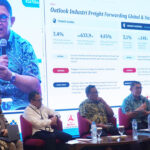









Indonesian freight forwarder Gateway Container Line is accelerating digital transformation and operational improvements as it seeks to sustain growth amid changing global logistics conditions.
Gateway Container Line Director Hesty Rosmawaty said rising shipment volumes alone would not be enough to remain competitive as logistics providers face higher customer expectations, supply chain disruptions and increasing pressure to improve efficiency.
Gateway has adopted the 2026 transformation theme, “Next-Gen Freight: Digital DNA, Sustainable Mission, Reliable Execution,” as the framework for its strategy, focusing on technology adoption, sustainability and operational reliability.
The company’s first strategic pillar, Digital DNA, aims to integrate business data, improve shipment visibility and support faster decision-making.
“Digitalization is no longer an option, but a necessity. Customers need real-time shipping information, while companies require accurate data to make faster and better decisions,” she said.
According to Hesty, digital tools improve shipment transparency for customers while helping the company enhance operational efficiency and respond more quickly to market changes.
The second pillar, Sustainable Mission, focuses on incorporating environmental considerations into logistics operations through improved resource efficiency and measurement of operational impacts.
Hesty said sustainability has become an increasingly important requirement for global customers, prompting logistics companies to align with international standards.
“In the future, logistics companies will not only be evaluated based on speed and cost, but also on their commitment to sustainability,” she said.
The third pillar, Reliable Execution, emphasizes strengthening operational processes and workforce capabilities to maintain service quality.
“Digitalization will not deliver maximum results if operational fundamentals are weak. We continue to improve human resources, internal processes and coordination with global partners,” Hesty said.
Gateway said the transformation supports its preparations to expand into fourth-party logistics (4PL) services, under which providers manage broader supply chain activities, including transportation, warehousing, customs clearance and distribution.
Looking ahead to the second half of 2026, the company expects logistics demand to remain supported by manufacturing activity, consumer industries and investment growth. It said geopolitical uncertainty, freight rate volatility and shipping capacity constraints would remain key risks.
Hesty said industry performance would largely depend on Indonesia’s economic growth, export and import activity, geopolitical developments, vessel capacity, freight rates and companies’ ability to adapt through technology and stronger business networks.
She said competition in the logistics sector is increasingly shifting beyond pricing.
“Customers need logistics partners that can provide reliable services, solutions during disruptions and technology support that improves the entire distribution process,” she said.
Gateway aims to sustain growth by strengthening its less-than-container load (LCL) consolidation business, expanding full-container-load (FCL) and air freight services, broadening its international network, improving shipment visibility and advancing sustainability initiatives.
“The objective is to build a company that is more reliable, more digital, more sustainable and more profitable for all stakeholders,” Hesty said.