

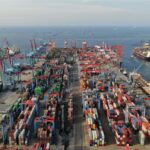

Business players say Tanjung Emas must expand quickly to accommodate rising exports, imports and industrial activity, strengthening Semarang’s role in Central Java’s growing trade network
For companies operating in the province’s expanding industrial estates, the time available to turn imported materials into export-ready products has shrunk sharply, making the reliability of the region’s main seaport increasingly important.
Business groups are now pressing authorities to accelerate the expansion of Tanjung Emas Port in Semarang, warning that bottlenecks at the gateway could encourage manufacturers to route cargo through larger ports in Jakarta or Surabaya instead.
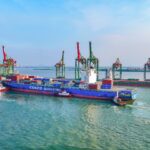
The calls came at a Sept. 10 discussion organized by Pelindo Terminal Petikemas to gather projections for industrial and cargo growth as it plans the future development of TPK Semarang, the container terminal at Tanjung Emas.
“Our expectations are indeed very high. We have been actively pursuing this since 2024, meeting with Customs leadership and the Governor of Central Java to push for Tanjung Emas to become a major port,” said Jarot Wibowo, chairman of the Central Java-DIY Bonded Zone Entrepreneurs Association.
Jarot said industrial output could not continue to grow without logistics infrastructure capable of moving goods quickly and reliably, particularly products destined for overseas markets.
Companies that once had as long as 150 days from purchase order and arrival of materials to export readiness now have about 75 days, he said.
That leaves less room for delays caused by congestion, equipment shortages or vessels waiting to enter or leave the port.
“If the port’s capacity and infrastructure are not improved, companies could shift their logistics operations to Tanjung Priok in Jakarta or Tanjung Perak in Surabaya,” Jarot said.
He called for equipment upgrades and terminal expansion to be carried out alongside development of temporary storage stations, or TPS, to reduce container congestion and speed the movement of cargo held at the terminal.
Jarot also urged the operator to use the current low season to tackle bottlenecks before peak demand and adverse weather return.
“Tanjung Emas must not become complacent. We are currently in the low season, so specific mitigation strategies are required,” he said. “When the peak season and bad weather arrive, we must avoid a recurrence of the container backlogs and long vessel waiting times seen in the past.”
Industrial growth outpaces infrastructure
The pressure on Tanjung Emas reflects a broader shift in Central Java’s industrial landscape.
New and expanding industrial estates, including developments in Batang Regency, are generating additional demand for imported materials, exports and domestic inter-island cargo.
“The market growth is extremely rapid, outpacing the development of port infrastructure and facilities. This demand must be met with adequate facilities,” said Efraim Zakka, manager at PT CMA-CGM Surabaya-Semarang.

Hari Ratmoko: “The basin of Tanjung Emas Port needs dredging, while the quay needs to be extended.”
Shipping and logistics companies also need greater certainty over the port’s development plans so they can take infrastructure readiness into account when making investment and expansion decisions, he said.
Efraim acknowledged improvements in technology and equipment at TPK Semarang but said future investment should focus on expanding the container yard and deepening channels and harbor basins to accommodate larger vessels.
“First and foremost, capacity needs to be increased, which means expanding the container yard. Furthermore, to attract larger vessels, the basin and channels must be sufficient to accommodate ships with deeper drafts,” he said.
Hari Ratmoko, chairman of the Indonesian National Shipowners Association Chapter Semarang (INSA Semarang), said continued investment was needed if Tanjung Emas was to capture more of Central Java’s economic potential.
He said container volumes at the port had brought it close to the level of larger gateways such as Tanjung Priok and Tanjung Perak, making additional capacity increasingly urgent.
“It is time to stop hesitating; we must act swiftly to foster rapid growth and development so that we can fully capture this economic potential,” Hari said.
The shipping channel is among the main constraints, he said, calling for dredging of both the channel and harbor basin and an extension of the wharf.
“The shipping channel must be deepened. The basin within Tanjung Emas Port also needs dredging because its depth has decreased. Furthermore, the wharf needs to be extended,” he said.
Teguh Arif Handoko, chairman of the Central Java and Yogyakarta chapter of the Indonesian Logistics and Forwarders Association, said the growth of industrial estates around Greater Semarang had made Tanjung Emas increasingly important as a logistics hub.
“It is essential for Tanjung Emas Port to serve as a primary gateway. The Central Java Provincial Government must not aggressively drive massive investment without ensuring that the necessary logistics infrastructure is in place,” Teguh said.
Without a balance between industrial investment and logistics capacity, cargo could migrate to competing ports, reducing the economic benefits generated by new investment in Central Java, he said.

Teguh Arif Handoko: “It is essential for Tanjung Emas Port to serve as a primary gateway.”
Teguh proposed a phased target of 1.2 million TEUs of service capacity at TPK Semarang by 2030.
That would mean handling an average of about 100,000 TEUs a month, or roughly 3,300 TEUs a day. But because container flows fluctuate, the terminal would also need reserve capacity to absorb periodic surges, he said.
“We need a benchmark—an initial target to start with. We don’t need to talk about reaching four million TEUs five or ten years down the line; the focus should be on how we can handle 1.2 million TEUs by 2030,” Teguh said.
Port expansion takes shape
I Nyoman Sutrisna, terminal head of TPK Semarang, said the Sept. 10 forum was intended to gather input from stakeholders on the terminal’s growth prospects and infrastructure requirements.
One of the main issues raised was the expansion of industrial areas, including new industrial zones in Batang Regency, he said. Such developments will be considered in planning for the terminal’s expansion.

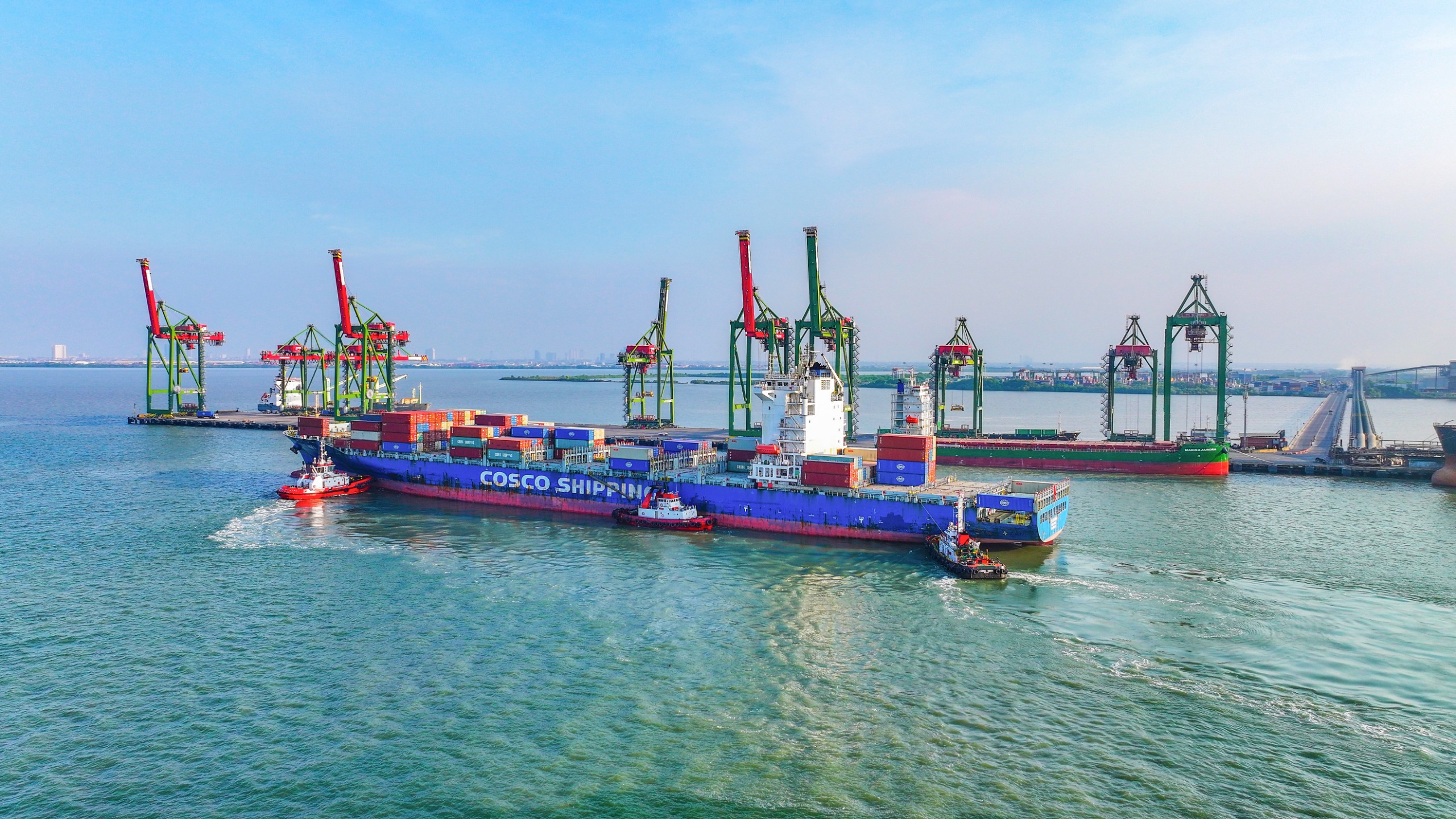
TPK Semarang has also acquired four additional cranes to increase its current service capacity, although Nyoman said equipment upgrades needed to be accompanied by longer-term planning.
“The addition of these four cranes is essentially aimed at increasing our current terminal capacity. However, we also need to discuss what the long-term outlook looks like,” he said.
Container throughput has been rising. Nyoman said volumes grew 16% between 2023 and 2025 and were projected to increase by about 9% in 2026. Throughput reached 1 million TEUs in 2025.
Data from PT Pelindo Terminal Petikemas showed TPK Semarang handled 698,500 TEUs in the first eight months of 2026, up 5.53% from 661,872 TEUs in the same period a year earlier.
International container throughput accounted for most of the increase, reaching 625,390 TEUs, up 8.53% year-on-year.
Imports rose 8.14% to 309,128 TEUs from 285,862 TEUs, while exports increased 8.88% to 316,159 TEUs from 290,380 TEUs.
Nyoman said the figures reinforced the case for Tanjung Emas to become a primary import-export gateway for Central Java.
The four new cranes would also allow the terminal to handle larger vessels, but the port’s channel and harbor basin would need to be sufficiently deep to accommodate ships with greater drafts.
“It is entirely feasible for Tanjung Emas to become a primary gateway. We currently possess cranes capable of handling large vessels with a width of up to 16 rows. The only challenge lies in the draft or the depth of the harbor channel,” Nyoman said.