







Indonesia’s importers are urging the Transportation Ministry to introduce regulations allowing cargo owners to pay terminal handling charges directly to port operators, potentially boosting state tax revenue.
Indonesia’s national importers association, GINSI, has urged the Ministry of Transportation to introduce regulations allowing cargo owners to pay Terminal Handling Charges (THC) directly to container terminal operators at Indonesian ports.
Under the proposed scheme, importers would make payments directly to domestic port operators rather than foreign shipping lines or their local agents.
GINSI Deputy Chairman Erwin Taufan said the arrangement could increase state revenue by ensuring that Value Added Tax (VAT) is collected on port handling services, while providing greater cost certainty for cargo owners by reducing exposure to fluctuations in the US dollar exchange rate.
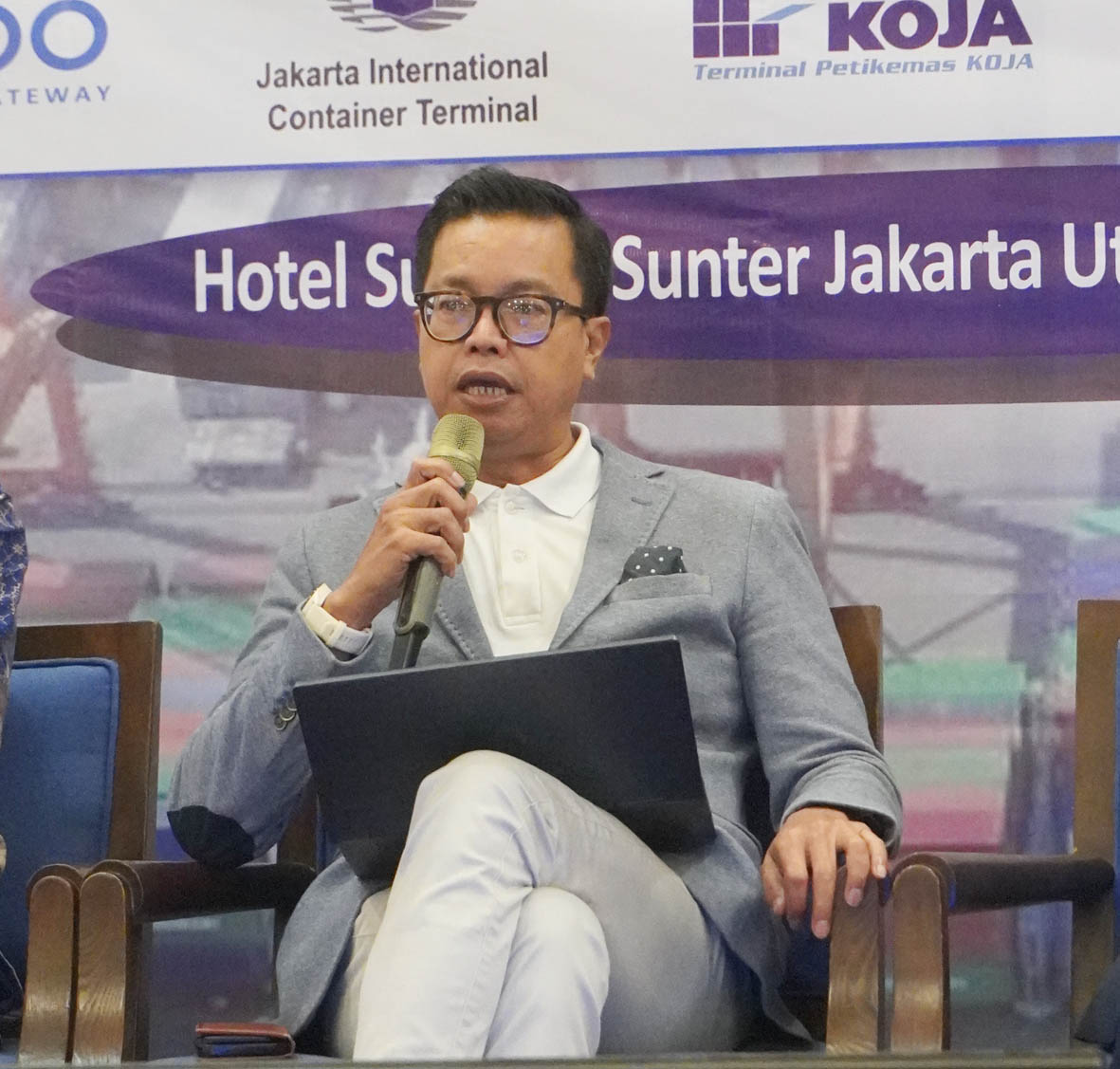
“Clear domestic regulations, such as a decree issued by the Minister of Transportation, are needed to ensure that THC can be paid directly by cargo owners to container terminal operators at Indonesian ports,” Taufan said in an official statement on Wednesday, Nov. 11.
He said importers currently pay THC to foreign shipping lines through their local agents without the 11% VAT being collected. The shipping agents subsequently pay container terminal operators a lower amount, classified as Container Handling Charges (CHC), also without VAT.
Under Cost, Insurance and Freight (CIF) and Cost and Freight (CNF) arrangements, importers are required to pay THC to shipping lines, although the physical handling services are performed by container terminal operators, Taufan said.
He said the prevailing THC rates were $95 per 20-foot container and $142.50 per 40-foot container, while shipping lines paid terminals CHC rates of $87 and $130.50, respectively.
Taufan argued that THC and CHC cover essentially the same operational activities, with the main difference being the payment arrangements.
He said the transactions were not subject to the 11% VAT because they involved foreign companies, resulting in potential tax revenue losses for the Indonesian government.
“Cargo owners should ideally pay container handling charges directly to the terminals rather than through shipping lines, as the terminals provide the equipment, personnel and operational services and bear responsibility when problems arise,” he said.
GINSI estimates that Indonesia’s combined export and import container traffic reaches 13 million twenty-foot equivalent units (TEUs) annually, comprising 65% 20-foot containers and 35% 40-foot containers.
Based on that estimate, annual traffic would comprise 8.45 million 20-foot containers and 2.275 million 40-foot containers.
Using CHC rates of $86 per 20-foot container and $129 per 40-foot container, and an assumed exchange rate of 18,000 rupiah per dollar, the respective handling charges would amount to 1.548 million rupiah/20ft and 2.322 million rupiah/40ft container.
GINSI calculated that applying the 11% VAT to these charges could generate approximately 2.02 trillion rupiah in annual state revenue.
The association estimated potential VAT receipts of 1.44 trillion rupiah from 20-foot containers and 581.08 billion rupiah from 40-foot containers.
Taufan called on the government to introduce firmer regulations governing port handling payments, saying the proposed changes would strengthen domestic control over Indonesia’s logistics sector.
He said the current arrangement left foreign shipping companies playing a dominant role in transactions involving services carried out by Indonesian port operators.